

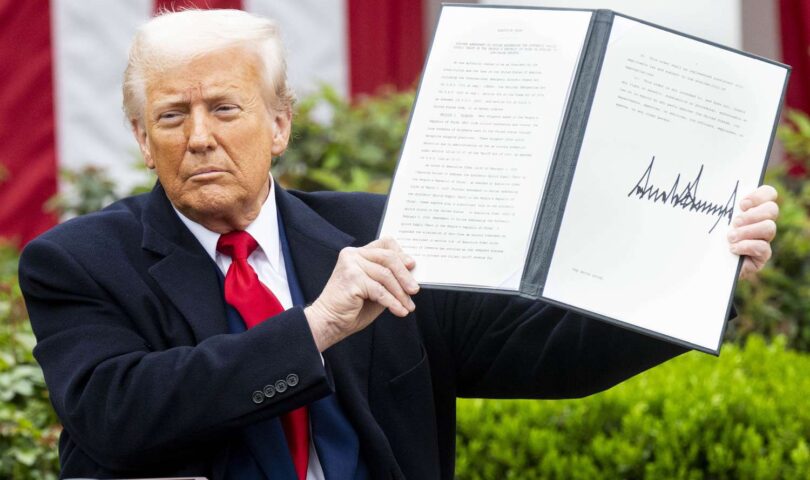
President Donald Trump has signed two executive orders Thursday aimed at restricting automatic U.S. citizenship for some children born in the United States, including those born through the commercial “birth tourism” industry, according to Axios.
The orders mark the Trump administration’s second attempt to narrow birthright citizenship after the Supreme Court limited the use of nationwide injunctions in challenges to the administration’s broader executive order in June.
One order would seek to deny automatic citizenship to children born to foreign nationals who enter the United States solely to give birth so their children can obtain U.S. citizenship, a practice commonly known as birth tourism.
The administration argued that mothers who enter the United States under false pretenses for the purpose of giving birth fall within a recognized exception to birthright citizenship because their entry was obtained through fraud, according to Axios.
The order also seeks to prevent the use of surrogate mothers as part of commercial birth tourism operations.
According to Axios, the order would apply only to future births.
Trump also signed a second executive order directing the secretaries of state and Homeland Security to develop new regulations and guidance aimed at cracking down on the birth tourism industry both inside the United States and overseas.
Federal regulations already prohibit foreign nationals from obtaining tourist visas primarily to give birth in the United States so a child can acquire U.S. citizenship, and immigration officials may deny entry if they determine that is the applicant’s primary purpose.
The administration also is seeking to expand other longstanding exceptions to birthright citizenship that it argues are recognized under the Constitution.
According to Axios, one provision would deny automatic citizenship to children born to certain foreign government employees stationed in the United States, expanding beyond the current exemption for diplomats and ambassadors’ families.
Another would apply to children of individuals designated as “alien enemies,” including members of organizations the federal government has designated as terrorist groups, Axios reported.
A third provision addresses U.S. territories.
Under the proposal, automatic citizenship for births in U.S. territories would end only if Congress first changes existing law.
Axios reported that legislation to do so was introduced last month but is not expected to advance.
The executive orders are widely expected to trigger another round of lawsuits.
Immigration advocates, civil rights organizations, and constitutional scholars have argued that the Supreme Court’s June ruling reaffirmed broad birthright citizenship protections under the 14th Amendment, while groups that successfully challenged Trump’s earlier executive order have signaled they are prepared to return to court if the administration pursues new restrictions.
The administration, however, argued the Supreme Court’s decision left room for narrower exceptions based on longstanding constitutional principles involving diplomats, hostile foreign actors, and fraudulent entry into the United States, according to Axios.
The orders are expected to face immediate legal challenges from immigration advocates, civil rights organizations and Democratic-led states, which are expected to argue the measures violate the 14th Amendment’s Citizenship Clause.
The Supreme Court on June 30 limited the use of nationwide injunctions against a broader executive order Trump signed on his first day back in office that sought to deny automatic citizenship to certain children born in the United States to noncitizen parents.
The new orders seek to take a narrower approach by targeting specific categories that the administration argues fall outside the Constitution’s guarantee of birthright citizenship, according to Axios.

- LSSU Senior Helps Power Technology Upgrade at Homestead Mission Operations Center - October 2, 2026
- Man charged after stealing front end loader - October 2, 2026
- Senate silent on gas tax suspension, adjourns with no movement - October 2, 2026