


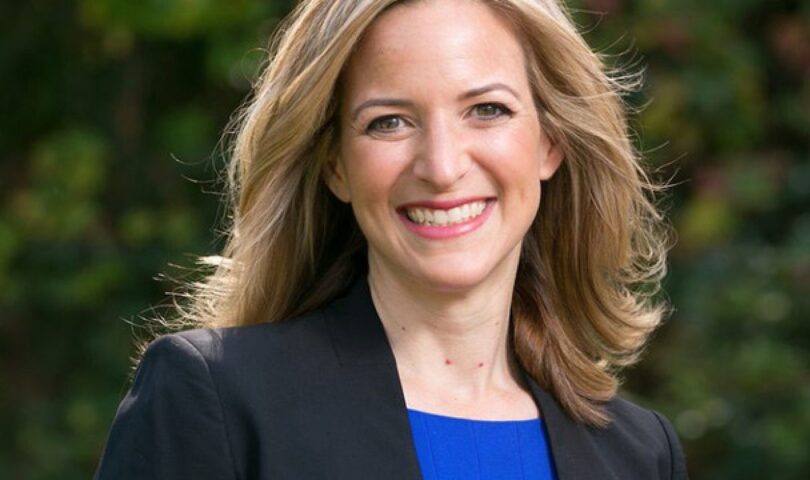
Michigan Republicans are highlighting Democratic gubernatorial nominee Jocelyn Benson’s connections to a civil-rights nonprofit facing criminal charges under President Donald Trump’s Department of Justice.
The Southern Poverty Law Center and one of its former executives are accused of defrauding donors by giving payments to members of extremist groups it had recruited as informants and even purchasing robes for the Ku Klux Klan.
Federal prosecutors claimed that by placing paid informants inside the organizations, the SPLC helped to boost the same hate groups they publicly crusaded against.
The SPLC had drawn the ire of Republicans by labeling some pro-Trump entities as “hate groups.” Critics of the prosecutions have argued the group is being prosecuted because of its adversarial stance toward Trump.
Benson, Michigan Democrats’ nominee to succeed Gov. Gretchen Whitmer, served on the SPLC’s board of directors from 2014 to 2018 — during the period of the alleged payments — and worked for the organization during and after college in the late 1990s and early 2000s.
John James, Benson’s GOP opponent in the gubernatorial race, has called herthe group’s “star operative.” A dark-money group called America Next is running a campaign ad calling Benson a leader of the group that “attacks Christians” and “even sent millions” to the Ku Klux Klan.
“The people of Michigan deserve answers when one of their most prominent public servants is deeply tied to an organization facing federal criminal charges,” House Oversight Committee Chair Jay DeBoyer said in a statement in late July — two weeks before James chose DeBoyer as his running mate.
Benson’s 2025 memoir details a long history with — and admiration for — the law center, which gained national prominence for its lawsuits against hate groups, but has also earned detractors on both the right and left since its founding in 1971.
Her campaign defended Benson’s work and criticized Republicans for trying to link her to the criminal case, arguing voters are “tired of these games.”

“Jocelyn Benson has spent her career advancing the unfinished work of the civil rights movement and expanding economic opportunity, including helping dismantle white supremacist and neo-Nazi extremist networks,” Benson campaign spokesperson Alyssa Bradley told Bridge Michigan in a statement.
Does Benson have anything to do with the current controversy and criminal charges the organization is facing, or has her previous work for the SPLC influenced her current role as secretary of state?
Here are the facts.
Benson’s SPLC connections
Benson joined the SPLC’s board while serving as dean of Wayne State University’s law school. Nonprofit filings from 2014 to 2018, when Benson served on the board, show she was not paid by the SPLC.
In a 2015 television segment, Benson said she was “very proud” to serve on the board, which was composed of 12 to 15 members during her tenure and was tasked with financial oversight of the organization and approving the budget. She left the post after she was elected secretary of state in November 2018.
In May, Benson told The Detroit News she was unaware of any payments the group made to informants and said her role on the board was “mostly ceremonial.”
Nothing in legal filings indicates Benson had less voting authority than other members of the board, but a separate team of executives ran the organization’s day-to-day operations.
The federal prosecution “smacks of something that’s purely political and retaliatory,” Benson told the newspaper, saying the group was “trying to do good work.”
Benson has a long history with the SPLC, predating her time on the board. In her book, “The Purposeful Warrior,” Benson said she worked for the organization as an unpaid intern while waiting tables on the side in the late 1990s.
She credited the experience with kindling her passion for civil rights.
Benson posed “as a freelance journalist, meeting with leaders and members of hate groups to gather information on their activities and plans,” she wrote. “I attended rallies and meetings, collecting and writing stories for the SPLC’s Intelligence Report.”
After college she returned to the SPLC to work there full-time, according to the Detroit Legal News, and Benson reportedly said the organization was her inspiration to become a lawyer.

The indictment
In April, Acting Attorney General Todd Blanche announced a federal grand jury had returned an indictment against the law center on charges including money laundering and wire fraud.
Last week, a federal grand jury returned an indictment with additional chargesagainst former group official Heidi Beirich, who had served as the law center’s intelligence project director while Benson was on the board.
The case is still in its early days in federal court, and defendants are considered innocent until proven guilty.
The indictments allege the SPLC paid informants within violent extremist groups more than $3 million between 2014 and 2023 as part of a scheme that federal prosecutors allege defrauded banks and the SPLC’s donors.
That overlaps with Benson’s time on the board, from 2014 to 2018.
She is not mentioned in the indictment. The board is mentioned once, in reference to a member who also served as the SPLC’s chief executive officer at the time of a 2021 bank statement.
The SPLC denies the allegations, arguing its payments to informants were part of a longstanding intelligence gathering program and that the charges against it are political, noting law enforcement has used information gleaned by the informants in past investigations.
The FBI — which had repeatedly worked with the SPLC and was reportedly aware of the informant program for years — severed ties with the group in October 2025.
The SPLC is not unfamiliar to criticism. Prior to 2016, a fair share of complaints came from liberals who found the organization too focused on maximizing fundraising and not focused enough on combating poverty and defending civil rights.
In recent years, the SPLC positioned itself as a foil of the Trump administration’s controversial civil rights initiatives. Its oft-cited listing of hate groups also broadened to include Trump-aligned groups — such as Moms for Liberty and Alliance Defending Freedom — leading criticism to bleed from the alt-right into the Republican mainstream.
Republican critiques
Federal officials have also not mentioned Benson in any public statements about the indictment or organization. But her critics argue that she had a duty to keep abreast of all the SPLC’s activities as a member of its board of directors.
Then-gubernatorial candidate Mike Cox lambasted Benson for saying she was not aware of the alleged informant payments, arguing as a board member Benson had a duty to know the organization’s activities.

“She either knew and was complicit, or she was asleep while this happened under her watch. Both are disqualifying. Both are damning.”
Weeks after the indictment, Republican gubernatorial candidate James wrote a column tying Benson to the SPLC for the conservative news site Daily Wire, calling her the group’s “star operative.”
James’ piece calls the group a “machine built to manufacture division, fundraise off fear and deploy operatives to use racial chaos as a path to institutional power.”
The piece does not offer any details about Benson’s alleged involvement in wrongdoing and his campaign did not respond to requests for comment.
House inquiry
The state House Oversight Committee chaired by James’ now running mate, DeBoyer, has also focused on Benson’s ties to the SPLC and demanded the Michigan Department of State hand over any communications between the department and the group.
The committee received 30 pages of emails, most of which were media requests asking Benson about the SPLC’s indictment. One exchange, however, showed Benson helped coordinate a tour of the SPLC’s offices with the National Association of Secretaries of State in 2019.
Republican Rep. Rachelle Smit contends the email proved Benson “maintained a working relationship with the Southern Poverty Law Center even after becoming secretary of state.”
The Michigan Department of State, through a spokesperson, declined to comment on whether Smit’s statement was accurate.
The Bottom Line
There’s no dispute Benson was on the board of the SPLC when the illegal payments allegedly were made to extremist groups.
There is uncertainty about how much power she wielded on the board and whether she would have been in a position to know about the payments.
Federal prosecutors have yet to prove the SPLC broke any laws.

- LSSU Senior Helps Power Technology Upgrade at Homestead Mission Operations Center - October 2, 2026
- Man charged after stealing front end loader - October 2, 2026
- Senate silent on gas tax suspension, adjourns with no movement - October 2, 2026












Why is this just now coming out? If this has been going on for a long time, it should have been brought out before she ran for Secretary of State. What is wrong with this country! What is wrong with the FBI, CIA, Homeland Security? A crook is a crook is a crook! Why are they all still in office? This is a great question!!!