


In 1923, Stanley Newton published “The Story of Sault Ste. Marie and Chippewa County.” This is part thirty-two of a continuing series about the history of Sault Ste. Marie and the area in its early years. I have left punctuation and grammar intact. – Laurie Davis
Millions Now Living Will See It
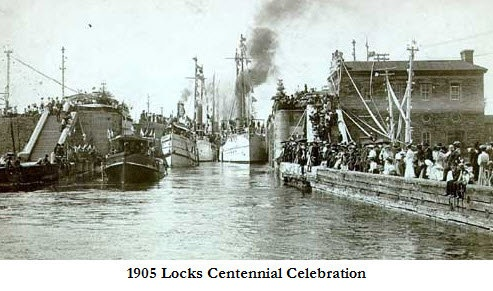
Already, a few smaller ships have found their way to and from Chicago, the head of the lakes, and old-world ports. Even as the first tiny locks presaged the colossal lake commerce of today, so do these beginnings of lake and ocean traffic foreshadow the tomorrow when great ocean liners shall lock through and dock at Sault Ste. Marie. Visions firmly held tend to materialize when they are in line with the trend of things. This is a little-known but long-proven psychological law. The ideals of Mr. Chas. P. Craig, Mr. W. S. Edward, our National Waterways Associations, and their supporters, are in accord with the basic trend of things, and nothing short of an earthquake or another war can long delay their fruition. It is a reasonable as well as a magnificent conception, this Great Lakes-to-the-Sea Waterway. Time must be a factor in the evolution of a plan so vast, but millions now living undoubtedly will see its completion and enjoy its benefits.
The Soo and Chippewa in the World War
Long before the United States entered the World War, Sault Ste. Marie and Chippewa County men were enlisting in the Canadian forces. From fifty to one hundred of our boys fought under foreign flags against the common foe. 1,300 soldiers enlisted in the United States forces during the period of our participation, most of them finding their way into the 32nd Division, and a very large number of the men from Sault Ste. Marie and Chippewa fought in the 125th and 337th U.S. Infantry.
Between ninety and one hundred local men enlisted during the period of the war in the Sault Ste. Marie recruiting offices of the Naval Reserve, and saw service in the U.S. Navy.
Enemies Once, Comrades Now
Records compiled during the war have been forwarded to Washington, and it is impossible at this time to set down detailed figures of enlistments and casualties here. About 150 Chippewa County soldiers and sailors died in the service. The descendants of the Indians, the French, the British, and the Americans who once fought for supremacy here laid down their lives as comrades on the fields of France. Some of our men fought with American units in Northern Russia, and at least one died there.
The Chippewa County Red Cross and other war agencies functioned finely when the need arose. A sufficient complement of troops remained at Fort Brady to guard the ship canal and the locks with the most scrupulous vigilance. The canal area was surrounded with barbed wire and soldiery, guardhouses were erected, and rapid-fire guns mounted at convenient points around the locks. The War Department took no chances with this aorta of the continent, while a record-breaking commerce pulsed through it daily.
A Royal Welcome Home
When the boys came home, they received a joyful and unforgettable welcome. A formal celebration in honor of their return was linked with an old-fashioned patriotic Fourth of July ovation, and the day will linger long in the memories of those who participated.
American Legion posts were organized in Sault Ste. Marie, Brimley, and Rudyard. The Sault Ste. Marie post is the most active of these, and it has been productive of much benefit and good comradeship to a loyal and enthusiastic membership. Its present officers are: Captain J. F. Young, Commander; Jay Gerrie, Finance Officer; Chas. McEvoy, Adjutant.
Men in Government service have taken a foremost part in the political, social, and economic life of Sault Ste. Marie since the beginning of the last century. It is probable that Washington is the only city in the United States that contains a greater proportion of the republic’s officials and employees.
Modern Fort Brady
Fort Brady, beautifully situated on a hill overlooking the city and the river, is a United States Army post under the Department of War. Its present commander is Captain Clinton Rush, and other commissioned officers are as follows: Captains: Barrett DeT. Lambert, Julian V. Link, Charles J. Isley. First lieutenants: Charles D. Simmonds, Frank B. Lindley, Zane I. Adair. Second lieutenants: James R. Hamilton, James D. O’Connell, Damond Gunn, E.D. Post. The enlisted men number 300 or more.
The great commercial importance of the locality was fully recognized by the War Department in the late struggle with Germany. The post was fully manned during the war, and the locks were guarded summer and winter by United States soldiers.
The U.S. Coast Guard
The U.S. Coast Guard, formerly known as the Revenue Cutter Service, is an arm of the Treasury Department, functioning under the Navy Department in time of war. Captain J.M. Moore is division commander and captain of the port of Sault Ste. Marie, and Lieutenant Commander C. A. Wheeler is division engineer. A force of fifty-seven enlisted men patrols St. Mary’s River during the season of navigation and maintains continuous watch at six lookout stations. These stations are connected with each other and with the commander’s office here by private telephone lines. The force was greatly augmented during the war, and it worked in cooperation with the War Department in closely guarding the St. Mary’s waterway from possible obstruction by enemy sympathizers.
Big Force on the Locks
Over one hundred Government officers and men, operating under the United States War Department, are employed at St. Mary’s Falls Canal and the locks. The officers are General Superintendent L. C. Sabin, Assistant Superintendent Isaac De Young. The superintendent in charge of traffic is Frank T. McArthur; his assistants are Patrick Tracy, Charles Hursley, and John Atkins. During the winter months, the force is lessened somewhat, but a great amount of continuous upkeep and repair work is necessary.

- Canoes Light and Graceful - September 1, 2026
- Dogs Pulled Heavy Loads - August 2, 2026
- Stones Contained Spirits - July 2, 2026










Thank you. Very interesting to read this past statement of the “Soo”.
Thank you for commenting. Since I was a young child, I have loved history, and it seems our community does, too. I love that our beloved community is so rich in it. As this series wraps up, I am debating whether to delve earlier into our history. I hope you continue reading.
Laurie