

In 1923, Stanley Newton published “The Story of Sault Ste. Marie and Chippewa County.” This is part two going back to the beginning of the Sault, in a continuing series about the history of Sault Ste. Marie. Punctuation and grammar have been left intact. – Laurie Davis
Names Dreamed by Others
Shortly after the boy’s birth, his father proceeded to dream for a name for him. You must understand that some Chippewa fathers named their children after a particular phenomenon of nature occurring about the time of its birth. Others commemorated in such names the happening of anything unusual among the people or animals in the vicinity of the birthplace. But commonly a name was selected that was based on one of the fantastic dreams constantly experienced by the Indians, and which exerted so tremendous an influence on their daily lives.
The father, then dreamed for a name, and having seen a gull in his dream, he called the boy Wabish ke pe nace, The White Bird. When the lad grew old enough to have companions they shortened this name of course to Wabish, which is to say, White. Wabish is the Chippewa name for rabbit, the animal which turns white in winter. Wabish was well named, for the day came when he was fleet as any rabbit, when he could run down and tire out the fleet-footed deer in the forest, especially after snow had fallen. But in the council house and on formal occasions he was, when grown to man’s estate. Wabish ke pe nace, and he took as his device and painted on his war axe the totem sign of his band, the Crane.
Early Training for War
In the years of his childhood even his toys were warlike. He played with arrowheads and flints, and his father made for him a tiny war club, lightly weighted at the end with pebbles sewn in deerskin. He tickled the ribs of his playmates with real arrows shot from a small bow. He learned to swim in the river’s shallow waters where Brady Field now stretches, for at that time the river bank was just north of the lodge where he was born. He learned to make rabbit snares and dreamed of the day when he might deadfall a bear. He wore crackly hides of the red deer, skins scraped, stretched, tanned, and sewed by his mother. The spring of the year found him on Sugar Island with his parents, where they gashed hundreds of trees for the sweet sap which he never tired of licking from his fingers. He helped to make the birch bark kettles in flammable receptacles which did not burn when filled with sap and hung over the fire. He collected dozy maple wood and moss for his father, who each morning started the fire in no time by holding a flint stone over the tindery mass and striking sparks into it with a piece of granite. It was almost as handy as a pocket full of matches.
When the hunting was poor and the whitefish failed to run in the rapids, Wabish lived for days on maple sugar and waxed fat on it. He knew where the wild onions and cucumbers grew in season and found many a bed of truffles or Indian potatoes in the black loamy soil on the edge of the swamp. He took his meat roasted underdone. Sometimes his mother prepared it on spits from which the bitter bark had been carefully removed. Or for a change she would heat a rock red hot by building a fire upon it, afterwards roasting the meat on the surface where fire had been. This process she varied by firing a small pit which she used for an oven for the meat and fish. Some gritty sand came out with the food, but the sand was clean. And for many summer weeks he took his fill of strawberries and blueberries which grew in unbelievable profusion all around. By and large he lived well, and if in the long winter the deer went far back into the country and the whitefish forsook the open rapids for a time, he usually found the family with a supply of jerked venison and smoked whitefish hanging from the cross pieces of the paternal nest, and dined nearly as well as ever.
River Was His Foster Mother
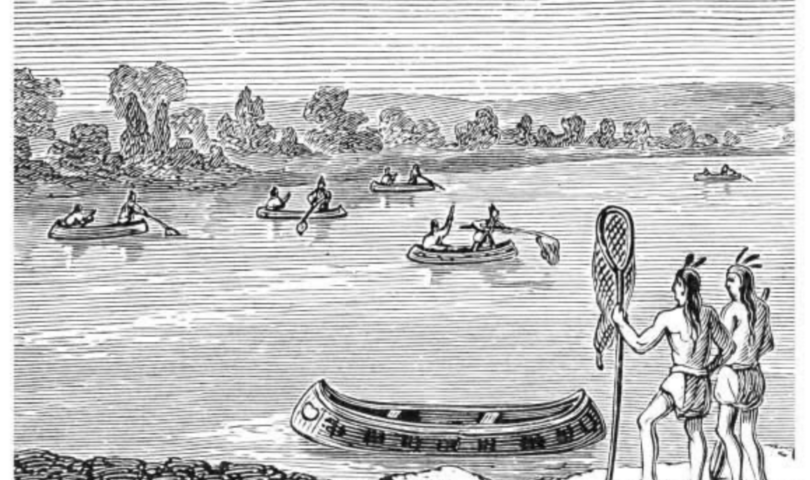
The mighty river was his foster mother, as it is ours. For untold centuries it was the Chippewa highway. Winter and summer its heavenly manna of whitefish fed the multitudes. Wabish knew that the whitefish grew from the brain of a wicked adulteress who had been cast into the rapids to drown, and whose head had been dashed to pieces on the shining black rocks.
Every now and then the medicine man or jossakeed of the Saulteur Chippewas propitiated the fishing nets of the tribe and persuaded them to make great catches of fish, by marrying the nets to young girls of the band with formal and solemn ceremonies. As it was indispensable that the brides should be virgins, mere children were chosen. Now this may appear absurd to you, but did not the Spirit of the nets appear to the forefathers of the Chippewas, saying that he had lost his wife and must have another equally as virtuous? Wabish realized that if the ceremony was neglected, or girls provided who were not immaculate, he would catch no more fish and he was grateful to the jossakeed accordingly.
Fish Addressed from the Banks
The fish no less than the nets required propitiation. On an evening they were eloquently addressed from the banks at the foot of the rapids, flattered, complimented, and exhorted to come and be caught, with the assurance that the utmost respect would be shown to their bones. This oration was according to the form laid down from olden times, and while it lasted those present except the jossakeed were required to lie flat on their backs and refrain from speaking a word.
In those days St. Mary’s River and its environs swarmed with Manitos, little gods, very potent for good or evil, mostly evil. All nature was spiritualized by Wabish and his friends. Every tree, rock, wind, stream, and star had a spirit. The thunder was an angry spirit, the milky way was the path of spirits on their way to celestial hunting grounds beyond the Northern Lights. The four cardinal points were spirits, the west being the oldest and the father of the others. Their mother was a beautiful girl who one day had permitted the west wind to blow upon her.
Then there were endless legends of windigos, great giants and cannibals, and tiny spirits and fays who haunted the woods, and the cataracts of Bowating and Tahquamenon. The Nibanaba mermaids, half fish, half woman, frolicked in the waters of Lake Superior. Many animals had a miraculous origin. The raccoon, for instance, was once a shell lying on the lake shore, until vivified by the sunbeam. The Chippewa name for raccoon, Ais e bun, means “he was a shell.”

- Opinion: Let’s Take Back Control of our Country - October 10, 2026
- He Discovers the Woman - October 3, 2026
- Canoes Light and Graceful - September 1, 2026