

In 1923, Stanley Newton published “The Story of Sault Ste. Marie and Chippewa County.” This is part three going back to the beginning of the Sault, in a continuing series about the history of Sault Ste. Marie. Punctuation and grammar have been left intact. – Laurie Davis
Wabish never wantonly stepped on any of the big boulders in St. Mary’s Rapids. He held them sacred, for he knew that a living spirit of flesh and blood breathed within their thin, hard shells.
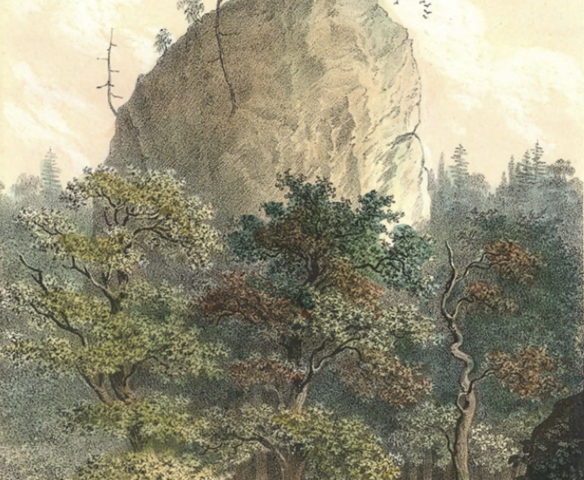
Once, his father took Wabish to the funeral of a chief on Michilimackinac, and the boy’s knees fluttered as he stood before Sugar Loaf, the abode of The One Great Spirit, the Maker of all. There he knelt in awed silence behind his father, who left votive offerings. Not his tribe alone worshipped here; hither came also the Hurons, Ottawas, Potawatomies, and Sioux in superstitious reverence. Even the blood thirsty Iroquois, having drifted north on some wild foray, laid aside their arms for a moment and meditated here. For eons before, the divine Gitchi Manito had taken residence in this mighty thumb of rock, when he flew from the north through Arch Rock to the Loaf. Wabish sensed the impenetrable dignity and majesty of the place and its occupant, and felt the ground was sacred. Indeed, so sacred had the ancient Chippewas held it, that Michilimackinac was inhabited by Indians only in comparative recent times. Formerly it was left to Gitchi Manito and the dead. It was the sanctuary of the benign Keeper of Souls, who welcomed in silence the supplications and sacrifices of his living red children and spread his protecting mantle over the shades of the departed.
A Manito Tree at Bowating
Wabish, then, enjoyed his visit to the national shrine, and was mightily interested, but he did not neglect his local religious duties. There was a Manito tree at Bowating, on the present site of Bingham avenue bridge. This tree was a big mountain ash, and sometimes even on calm and cloudless days, Wabish and his friends heard the sound of distant war drums rolling among its leaves. They knew from this that the tree was the abode of spirits, and they deemed it sacred. So they made frequent offerings there, and their descendants continued to add to the pile at its foot even after a storm had wrecked the tree, until at last the whites cleared the ruins away and violated the site with a wagon road.
Almost upon the site of the Chippewa County courthouse there was formerly a limestone boulder of huge dimensions, where no doubt Wabish came often for devotions. One side of this stone was covered with Indian inscriptions and picture writing. Clearly the stone was regarded as a Manito’s dwelling by the ancient Chippewas, and tradition tells us that many worshiped there. When the contract was made for the construction of the courthouse, Judge Steere, recognizing the value of the stone as an historical and ethnological landmark, arranged with the contractor to guard carefully this boulder from desecration. But in the absence of the contractor some of his men built a fire against the stone and cracked off the face bearing the inscriptions. Afterward the rock was broken into pieces and used for building.
On the premises of a Ridge street home in Sault Ste. Marie there is a peculiar stone about six feet square, which probably was venerated by the Chippewas as the home of a Manito. The stone bears no glyphs, but the Indians say it was once much larger than at present, and was believed by their ancestors to be the abode of a Spirit to whom they prayed.
Wabish had a regard amounting almost to veneration for his family sign or totem, the Crane. When as a brave he went to war, he painted the sign of the Crane in vermilion upon his forehead. Most of his Saulteur friends belonged to the Crane or the Owl band. The Chippewas in the vicinity of Michilimackinac were the sons of the Turtle. Others wore the Snake insignia, or the Wolf, the Bear, or the Weasel.
Totem Denoted Town or Branch
The word “totem” appears to have been derived from the Indian word for “town.” It is likely that the inhabitants of a town or village once were considered to be of the same family or clan, consequently they all assumed the same badge or totem. The symbol became the evidence of consanguinity, hence the importance of totems, which denoted the family branch. The meanest Indian had his totem. He took pride in his ancestry, followed its honorable traditions and strove to measure up to the greatest of his clan. But when he married his wife retained her family mark.
Wabish became a great traveler, and often used his totem mark when traversing the forests, to convey desired intelligence to his friends. He would take a piece of birch bark and scrawl his totem thereon with a coal, and the totems of any other travelers or hunters accompanying him, drawing each in size of the order of his importance. If at the time of writing he had been absent say three days from Bowating, he drew three suns on the bark. If any of the party had died or suffered a serious accident, he was represented without a head or lying on his side. This sign-writing Wabish would place in the cleft of a pole, angling the pole in the direction he was going. In summer he left beneath it a handful of green leaves, and the degree of their withering conveyed a good idea of the time he had passed that way. In winter his snowshoe tracks told their own story.
Long Snowshoe Trips
When Wabish’s ancestors invented the snowshoe they conceived something wonderfully adapted to its purpose. Wabish learned to make his own snowshoes and found them indispensable for winter traveling in the Bowating country. The only wood he used in their construction was their encircling bows and the cross-pieces, the rest being made of interlaced thongs of buckskin, deer sinews or rawhide. Though light, his shoes were strong enough to support his weight easily even in very soft snow. His heelless moccasins adjusted themselves perfectly to the shoes, and he kept his feet and legs warm on the trail by strips of “nip” or fur, wound around them. The snowshoes were attached only at the toes, so that when his feet rose in walking, the tails of the shoes dragged and needed to be lifted partially only. Wabish once walked on snowshoes from Bowating to Michilimackinac in a day, a distance of sixty miles. Stretches of seventy-five miles by Chippewas in a day were not uncommon. More than once Wabish ran down a deer on his snowshoes, for the narrow hoofs of the deer did not support them in the soft snow.
Another striking characteristic of old Bowating, used by Wabish and his fellow Chippewas, was the dog train. In ancient times nearly every Indian of any importance had his dog train. Thousands of people now living in the north do not know what a dog train is.
The train was a thin board of elm or other tough wood, about fifteen inches wide and four to six feet long. The front of the board was turned up and lashed back, with cross pieces or stiffeners along the top of the board, and cords or thongs running along each side. The modern toboggan is white civilization’s adaptation of the Chippewa dog train. The train was made flat and broad so that it might draw easily on lightly crusted snow, and the load was strapped to the train.

- Canoes Light and Graceful - September 1, 2026
- Dogs Pulled Heavy Loads - August 2, 2026
- Stones Contained Spirits - July 2, 2026