


In 1923, Stanley Newton published “The Story of Sault Ste. Marie and Chippewa County.” This is part four going back to the beginning of the Sault, in a continuing series about the history of Sault Ste. Marie. Punctuation and grammar have been left intact. – Laurie Davis
The dogs used by Wabish and his pals were good sized ones of no particular species, though commonly dark in color. The Chippewa dogs probably descended from Arctic wolves caught young and brought down to Bowating land centuries ago, when the tribe made its migration from Asia – if indeed the tribal influx came that way. They were harnessed somewhat as horses are harnessed, having breast straps to which the traces were attached. The dogs were driven either tandem or two abreast, and two dogs could draw about 600 pounds on a good road. When the road was heavy or hilly Wabish would walk ahead of the dogs on snowshoes, and another Indian behind held a line fastened to the rear of the train, with which he checked it when going down hill.
On a long journey the food for the dogs was corn meal cooked with a little tallow. This kept the dogs in good working condition without fattening them. Each winter found the Bowating dogs fit and eager for work or play, and many a dog train race had Wabish with the teams of his cronies on the level winter ice below the rapids.
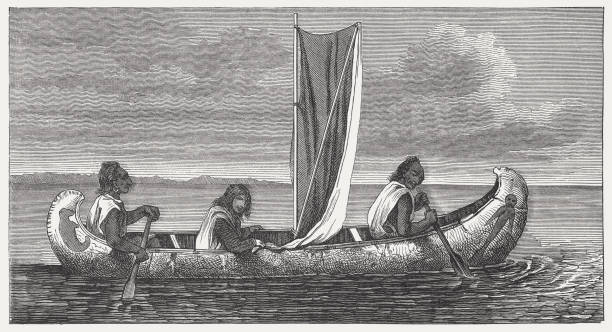
The Saulteur Chippewas employed canoes almost as constantly as other nomadic races do horses or camels. In the long days of summer Wabish fairly lived in his birchbark. Boating was the home of the birch tree, and here Manibosho had taught his children how to make their fairy-like and feathery canoes from the bark of the birch.
Makes Real Canoe
Lay aside your cloak, O birch tree!
Lay aside your white skin wrapper.
It was Wabish’s uncle who showed the boy how to make a real canoe. Just above the rapids was a grove of birch trees, and to these the man and boy made their appeal, not in the fabled words of Hiawatha, but with good sharp
stone. They picked the largest and smoothest trees, so that the piece of bark might be as large and clean as possible, and less sewing would be necessary. They scraped and scraped with stones the inner side of the fresh bark, just as a tanner does a hide. These great leaves of bark they brought to the squaws in the village, who sewed them with bone needles and spruce-root thread into sheets big enough to cover the whole frame of the canoe. The boy’s uncle, My een gun, The Wolf, and Wabish meanwhile made the framework of the boat from the elastic branches of cedar trees. The Wolf was the expert canoe builder of his clan, and he kept back of his wigwam on the shore two or three rude models of canoes, around one of which he now bent the branches or ribs of Wabish’s canoe.
These ribs were peeled almost unbelievably thin by The Wolf, as he explained to Wabish, the prime necessity of lightness and easy carriage in a canoe. Then he fastened thin cross-pieces between the upper ends of the ribs. Wabish thought at first they were very narrow seats, much too narrow, but they served merely to give strength to the sides.
No Nails or Screws Needed
In modern boats the ribs are supported by the keel, from which they stand out like branches of a tree. But Wabish’s canoe had no keel, and the ribs and cross-pieces were tied necessarily to a piece of wood at the top. This strip ran all the way around the gunwale of the boat, so that, in lieu of a keel, it acted as the back bone of the canoe.
There wasn’t a nail or screw in the whole affair. Everything was sewn, tied, or pitched together. And the seams, stitches and knots were so strong, so regular, firm and artistic that nails weren’t needed at all. The bast of cedars made a perfect substitute.
The framework had been made in this way by the two, with much advice and some assistance by lookers-on, the bark covering was spread out on the ground and the skeleton laid over it. When the bark was pulled up over the frame the job looked for all the world like the handiwork of a cobbler upon a giant shoe, with the leather wrapped around a huge cast. With great care they drew the bark sheet as tightly as possible around the frame, and turned down the edges over the gunwale strip, to which they firmly bound them. Finally, a reinforcement of birchbark armor was fastened all along the edge, protecting in some small measure the frail craft from the coming inevitable bumps.
After this they lined the bottom of the canoe with thin strips, laid across the ribs and lengthwise of the canoe. These were vital, but for their protection even the soft-moccasined foot of Wabish would have punctured the canoe-bottom as if it had been paper. Birchbarks were not suited to the nailed boots of the whites, or to the carriage of their heavy iron shod boxes. They welcomed only the pussy-footing tread of the Indian or the soft thud of his bundles of furs.
When the women of Bowating had nothing else to do, they always found a demand for wa tap, the twisted thin split roots of the spruce. They could make either fine twine or heavy stout cords from these roots, and great quantities were used yearly at Bowating, in fishing nets as well as the building of boats. The ropes or cords in the nets used so freely in the rapids were often fifty yards long. These strong nets resisted the action of the water for years. When laid up they became very dry and brittle, but a good damping made them supple as leather again.
Wabish’s canoe was sharp, front and back, it was slightly broader in front, and the ends stood up a little. A small piece of wood was inserted in either end, to lend increased strength to the frame; and on one of these Wabish painted with infinite care, and on the other he carved with infinite labor, facsimiles of his paternal totem, the Crane. The ends of his craft he also daubed most beautifully and artistically with yellow ochre and vermilion from the south shore of Gitchi Gumi.
Fills Holes with Resin
The final process was one of pitching and repitching all the little holes, seams and stitches in the canoe. For this purpose the heated resin of the pine or fir was used freely. The weak parts of the bark, or the holes of small branches were also plastered with this water-defying resin or pitch.
Wabish paddled his canoe in much the same manner as Charon propelled his bark on the river Styx, or as men and women have used paddles in small boats the world over. His paddle was short and broad, made of cedar, light and tough. But on long water journeys he carried paddles of hard maple, alternately kneeling on the fur covered strips, or sitting on the small seat slung from the stiffened gunwale by thongs of rawhide.
Wabish’s first canoe accommodated two people. It lasted four years because he took great care of it. After he became proficient in canoe-making he waxed careless, and sometimes a canoe lasted him but a moon or two. Then, too, he was forever shooting the rapids, and forever getting nicked there. When this happened he found it wise to seek the shore without undue delay. Sometimes he brought his craft to the beach; occasionally the knife-thin bark took water so quickly that it sank beneath him and he had to swim for it. That meant another canoe, generally a better and more elaborate one.

- Canoes Light and Graceful - September 1, 2026
- Dogs Pulled Heavy Loads - August 2, 2026
- Stones Contained Spirits - July 2, 2026