

In 1923, Stanley Newton published “The Story of Sault Ste. Marie and Chippewa County.” This is part thirty of a continuing series about the history of Sault Ste. Marie and the area in its early years. I have left punctuation and grammar intact. – Laurie Davis
In 1908, Mr. Osborn succeeded the Hon. Peter White as Regent of the University of Michigan. In 1910, he became a candidate for governor at the Republican primaries, defeating Patrick H. Kelley and Amos Musselman. In the election, he won over Lawton T. Hemans by a plurality of 43,000 votes.
Two years followed of strenuous fighting for what the Governor believed to be right. At his instigation, a workmen’s compensation measure was introduced and passed. He saw to it that a bill was introduced making it illegal for brewers and distillers to own or encourage saloons in Michigan. The bill became a law. A woman suffrage bill carrying the Governor’s hearty endorsement was defeated. Women’s suffrage was not adopted by the State until 1918, two years after statewide prohibition was carried out. The Governor had been ahead of his time.
When Chase S. Osborn became Governor, there was a deficit of about one million dollars in the state treasury. At the conclusion of his administration, the State was out of debt and the treasury held a surplus exceeding two million dollars. He awakened the people of Michigan to a finer and stronger conception of government. The ideals he inspired and exemplified have created in many ways a better State. Success did not spoil him, and his political enemies conceded him their admiration when they denied and defeated his plans for the betterment of Michigan.
Returning home from a foreign trip with Mrs. Osborn of almost two years, Mr. Osborn was importuned by friends to be again a candidate for the governship nomination. He won the nomination, but was defeated in election. In 1918, he contested with Henry Ford and Truman H. Newberry the Republican primary nomination for United States Senator from Michigan. Mr. Newberry won the nomination and the election.. While they are both sympathetic and kindly men, it isn’t likely that either Mr. Osborn or Mr. Ford shed any tears over what happened to Mr. Newberry afterward.
Most Widely Traveled Man
A Detroit newspaper calls Mr. Osborn the most widely traveled man on earth. No country worth visiting has been missed by him or Mrs. Osborn, and they are intimately acquainted with many lands. The story of his life is told in his autobiography, “The Iron Hunter,” written as autobiographies should be written, plainly, sincerely, palliating nothing, excusing nothing. It is free from embroidery and puts on no dog. “Putting on dog” is the Saulteur expression for snobbery; uppishness; false fronts; trying to make people believe you are better or wiser or richer or holier than you really are or ever will be. The Chippewa Indians originated the term, and the meaning is the same in their language.
You should read “The Iron Hunter,” as it is a book that will class with the autobiographies of Rousseau, Cellini, and Trudeau. If you have a young man in the family, start him on “The Iron Hunter,” and watch him devour it. It is a stirring tale of pioneering, of a career possible only in a new and free country like America. It has all the freshness and the vigor of a northern spring morning.
“My hometown, Sault Ste. Marie, Michigan,” says Mr. Osborn in “The Iron Hunter,” has always shown me a sympathy and a friendship and support that would be a sufficient reward for any man, no matter if his deserts were easily much greater than mine; and an inspiration as well. In return for its attitude, I loved the town and all its people.”
Osborn’s Gifts to Sault Ste. Marie
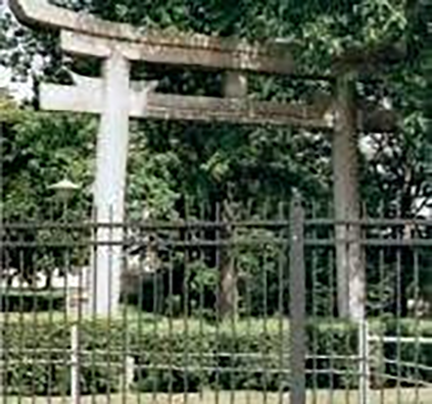
Again and again, Sault Ste. Marie has had concrete evidence of Mr. Osborn’s goodwill. The stone torii and the Shinto memorial lanterns in Canal Park; the bronze Lupa di Roma, the she wolf mothering Romulus and Remus; the stone lions at the Carnegie Library; the chimes of eleven bells in St. James Church tower; the multitude of elms given for the cure of a former treeless city and reminiscent of ancient times; the curios in the Melville Museum at the Senior High School; the paintings by foremost artists, including Moran’s famous “Grand Canyon” in the music room at Senior High; the revolving illuminated cross which crowns the Methodist Episcopal church on Spruce Street; the grounds at Douglas Street and Portage Avenue; these are some of the gifts of Mr. Osborn to Sault Ste. Marie and to all its people.
While history was being made in the little city beside the rapids, an ever-increasing ship traffic passed around them. Imperious need developed for longer, wider, and deeper steamers. The fast-expanding fields and mines of the north and west, found two American locks and one Canadian lock in St. Mary’s River utterly inadequate to accommodate their bounty in its passage to the markets of the world.
Four American Locks
St. Mary’s Falls Canal is one and three-fifths miles in length and 160 feet wide. It feeds four locks, two of which have been described. The third lock, 1,350 feet long, 80 feet wide, and having 24.5 feet of water upon its miter sills at low water, was built by the Government in the years 1908 to 1914, and opened to traffic on October 21 of the latter year. The fourth lock, of the same dimensions as the third, was built by the Government in the years 1913 to 1919, and opened to traffic on September 18, 1919.
Since 1892, the canal leading to the Weitzel and the Poe locks, has been deepened in its upper reaches to 24 feet. The new canal leading to the third and fourth locks has a least depth of 24 feet.
The canal also practically includes those parts of the channel through St. Mary’s River, which have been improved through shoals of sand, clay boulders, sandstone, and limestone rock. The United States Government made the first appropriation for improving the river channels in 1856. Work on their betterment has been almost continuous, so that the dredged areas now total 45 miles in length with a least width of 300 feet, increasing at angles and at other critical places up to 1,000 feet. In 1903, excavation of the Middle and West Neebish channels was begun for 21 feet at the lowest stage of water. The West Neebish channel was opened to commerce in 1908, and the deepening of the Middle Neebish channel was completed in 1912. Downbound traffic uses the West Neebish channel and upbound traffic the Middle Neebish route. The cost of the third and fourth locks and their approaches was $7,500,000, and the total cost of the improvements in St. Mary’s River, including all locks, canals, and betterments to channels, is approximately $31,000,000.
Hydraulic power is used for operating the Weitzel and Poe locks. Electricity generated by water power is used for operating the third and fourth locks on the American side and the Canadian lock. Three watches of eight hours each operate the American locks, and the force engaged in passing boats through the American locks aggregates 120.

- Canoes Light and Graceful - September 1, 2026
- Dogs Pulled Heavy Loads - August 2, 2026
- Stones Contained Spirits - July 2, 2026