

In 1923, Stanley Newton published “The Story of Sault Ste. Marie and Chippewa County.” This is part one going back to the beginning of the Sault, in a continuing series about the history of Sault Ste. Marie. Punctuation and grammar have been left intact. – Laurie Davis
The Land of the North
There is a glamor in the singing pines,
There is a glint upon thy hardy flowers,
A lusty beauty in the forest vines
Proclaims the magic of thy sunny hours;
Thou subtle North! where diverse spells beguile
And land and lake conspire to tease to wile,
From hill to wave, from stream to sapphire sky;
Bring to this pageant all the glorious past,
Blend with these charms tradition’s rosy glow;
Cherish thy gallants, heroes first to last,
It is thy richer crown, the lore of long ago!
Bowating in Immemorial Times
“Aboriginal history on this continent,” says Schoolcraft, “is more celebrated for preserving its fables than its facts. A world growing out of a tortoise’s back – the globe reconstructed from the earth clutched in a muskrat’s paw, after a deluge, – such are the fables or allegories from which we are to frame their ancient history.”
Such criticism seems unjust. Napoleon Bonaparte, who was certainly a much greater man than Henry Rowe Schoolcraft, was fond of saying that history is a lie agreed upon. Now if we agree to this – and many of us do – we cannot impugn consistently the Ojibways’ stories of their origin, their forbears, their achievements, and their gods. When an Indian good friend of mine tells me that the demi-god Manibosho found safety in a tree when the world was deluged, and afterward builded another world from the abysmal ooze which a hell-diver brought him, I am an interested listener. Further, when I am told that the Sault rapids were once at Iroquois Point, where a giant dam stretched from cape to cape, and that Manibosho killed his wife for not guarding the dam in his absence, I am convinced. For I have seen the old lady lying there on the Goulais side of Gros Cap, turned to red stone and half submerged in the waters of Lake Superior.
Believed by Ojibways
At least I am as much convinced as my informant would be if I told him the story of Noah and the Ark. Neither version is capable of proof, each must be taken on faith.
Great numbers of Ojibway Indians, commonly called Chippewas have believed the stories I am about to relate. For all I know, many of them still believe. These stories are placed in the opening chapters of this book, with a brief examination of the ancient life of the Bowating Indians, in order that you may the better understand the reaction of Indian to white man in the recorded history which follows.
Every normal white man or woman is just naturally interested in Indians. They were our first families. Their roving lives, wild and free, their deer and bear hunting, their burnings at the stake, the devilishly painted face, the tomahawk, the scalping knife, the necklace of scalps, the medicine man, the unsurpassed Indian orator in council, the pipe of peace – ah, what a treasure trove of breathless interest are these! He who eyes for the first time an old Indian stone axe, instinctively visualizes the skulls it has split. The child on your knee by the evening fire craves Injun stories. There’s a wonderfully satisfying thrill in the yelling, galloping Indian at the Wild West show.
The Home of Manito
We of the North take a decent pride in the wildness of our ancient Indians. They were as fierce, as gentle, as high minded, as eloquent, as cruel, as efficient in their way as any other tribes the continent has mothered. This north country was the home of Manito, The Great Spirit. It was the abiding place of Manibosho, Protector of all good Chippewas. And by the way, when you pronounce the name of the Chippewas’ demigod, bring it up as it were from the bottom of your lungs, accent on the last syllable almost to the point of coughing, – Manibo-sho, a most remarkable being worthy of your deepest consideration, whose grandmother was a toad, and whose great-grandmother was the Moon. You may doubt this statement, but I defy you to disprove it. And his true, his authentic home was on the very spot where this book was written and printed.
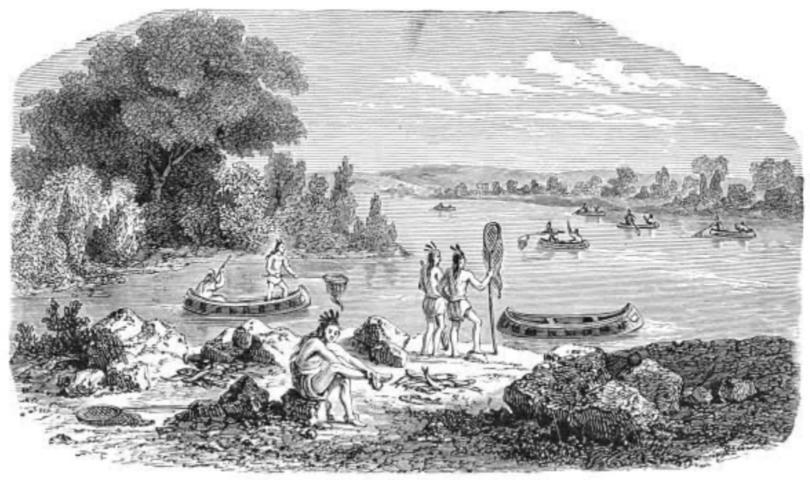
Once upon a time the banks of St. Mary’s River at the rapids were the greatest Indian camping place in the whole Northwest if not in America. Here was the Chippewa capital, the great central meeting-place from time immemorial. Here was the joining of the three greatest lakes – Gitchi Gumi, or Superior; Meetchigong, or Michigan; and Tionnontateronnon, or Huron and Georgian Bay. Hither the northern Indian gravitated by birch bark canoe in summer, or by snowshoe over the smooth frozen surfaces in winter. The deer hunting was good. The rapids afforded a seldom failing supply of delicious whitefish, a food of which one never tires. The fertile clay meadows along the river yielded hardy Indian corn abundantly. Firewood was plentiful. The Chippewas were powerful and content, and held their wigwams and the revered resting place of their dead against all comers. It was a northern Indian paradise.
The Story of Wabish
Let us go back in fancy to the year 1600, half a century or so before the first white man ascended the mighty river, and consider the life of a typical Chippewa Indian in the vicinity of what is now Sault Ste. Marie.
Wabish was born at dawn of a June morning on the present site of the Sault Ste. Marie post office. He first saw the light of day in a pole and bark wigwam, one of the many constructed here by the women of his band. Their hands had cut and dragged from the woods near by the young trees constituting the framework of the dwelling. These trees had been trimmed and stuck in the ground in a quadrangular parallelogram, the longest sides running from the entrance to the back of the hut. Two trees were planted in front, forming the door, and two at the rear, where the seat of honor was raised. The side rows of trees had been bent forward at their tops, and the ends twisted around each other and secured with tough bastimpugn of the cedar tree. The skeleton thus formed was clothed with apakwas or rolls of birch bark, the operation of covering having begun at the bottom. The second row hung down over the first, thus shedding the rain, and a third and fourth row completed the sides. Other apakwas were thrown crossways over the hut, and were weighted with stones hanging from cords of sinews. There was a smoke hole in the center of the roof, and a mat of deer-skins over the space left as a doorway.
Immediately after his birth young Wabish ke pe nace – for so his father named him was stretched out by the midwives in the waiting cradle or tikinagan. His tender limbs were laid straight on a board of poplar wood on which a thin peeled frame, also of poplar, was fastened, conforming in shape to his body, and standing up like the sides of a violin from its sounding board. A stout mat over this completed a cavity in which he was carefully packed in a mixture composed of dry moss, rotted cedar wood and the wool from the seeds of water reeds and cat-o-nine tails. But first his feet were placed exactly perpendicular, parallel, and close together. Thus, even in the cradle, care was taken that they should not turn outward. A Chippewa Indian must be a good walker, and Wabish, when he grew up, covered a good inch more of ground at each step than the coming white men who turned their feet out. There was the winter to think of too, and the straight ahead footing on snowshoes. The women paid great attention to his nose also, and tried to pull it out as long as the cartilage remained soft, for a large nose was an ornament among the Chippewas.

- Canoes Light and Graceful - September 1, 2026
- Dogs Pulled Heavy Loads - August 2, 2026
- Stones Contained Spirits - July 2, 2026