

In 1923, Stanley Newton published “The Story of Sault Ste. Marie and Chippewa County.” This is part twenty-nine of a continuing series about the history of Sault Ste. Marie and the area in its early years. I have left punctuation and grammar intact. – Laurie Davis
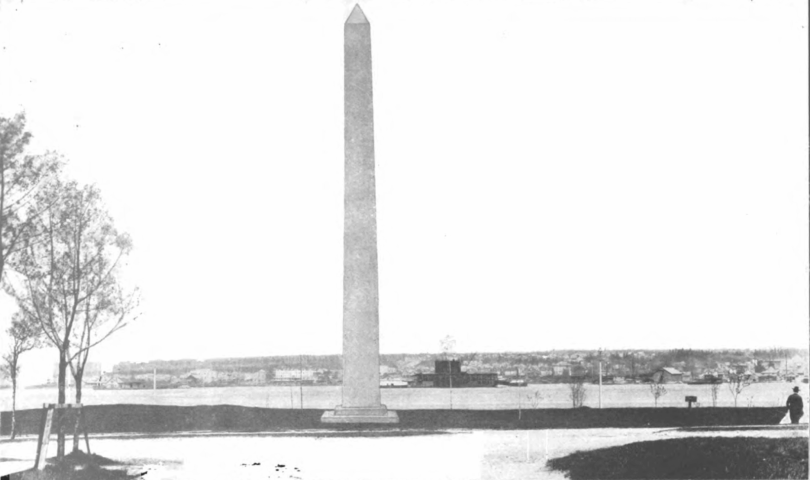
A permanent memorial of Connecticut granite, forty-four feet in height, was erected at the foot of Bingham Avenue in Sault Ste. Marie by the United States, the State of Michigan, and the mining and transportation interests of the Great Lakes, commemorating the fiftieth anniversary of the opening of St. Mary’s Falls Canal and the celebration of 1905. In form and material, the monument follows the most enduring of Egyptian obelisks. The design was chosen because it was deemed best suited to commemorate works of engineering. Bronze tablets affixed to the four faces of the shaft bear the following inscriptions of historic interest:
North Tablet
Besides these rapids, June 14, 1671, Daumont De Lusson, Nicolas Perrot, Louis Joliet, and Fathers Dablon, Druilletes, Allouez, and Andre claimed possession of all the lands from the seas of the north and west to the south seas. For Louis XIV of France. In 1763, the lake region was ceded to England as a portion of Canada, and at the close of the revolution, Saint Mary’s River became part of the national boundaries. In 1797, the Northwest Fur Company built a bateau canal and lock on the Canadian bank. In 1820, Lewis Cass, Governor of Michigan territory, established the authority of the United States, from the Great Lakes to the Mississippi River.
East Tablet
The XXXII Congress having made a grant of public lands to aid the construction of a ship canal around Saint Mary’s Falls, the state of Michigan contracted with Joseph P. Fairbanks, John W. Brooks, Erastus Corning, August Belmont, Henry Dwight, Jr., and Thomas Dwyer, Principals; and Franklin Moore, George F. Porter, John Owen, James F. Joy, and Henry P. Baldwin, Sureties, to build a canal according to the plans of Captain Augustus Canfield, U.S.A. The work of construction was accomplished by Charles T. Harvey, C.E., who overcame many serious obstacles incident to the remote situation. The canal, opened June 18, 1855, was operated by the state until June 9, 1881, when it was transferred to the United States and made free to all vessels. Superintendents under the state: John Burt, Elisha Calkins, Samuel P. Mead, George W. Brown, Guy Carleton, Frank Gorton, John Spalding.
West Tablet
In 1856, Congress first made appropriations to improve Saint Mary’s River under the direction of the Corps of Engineers, U.S.A. Captain John Navarre Macomb and Captain Amiel Weeks Whipple had charge of the work until 1861, and Colonel Thomas Jefferson Cram, Major Walter MacFarlane, and Major Orlando Metcalfe Poe from 1866 to 1873. The Weitzel Lock was built between 1876 and 1881 by Major Godfrey Weitzel, assisted by Captain Alexander Mackenzie. Major Francis Ulric FarQuhar and Captain David Wright Lockwood were in charge, 1882-83. From 1883 to 1896, the canal was enlarged and the Poe Lock was built by Colonel Poe on the site of the state locks. From 1895 to 1905, the officers in charge successively were Lieutenant James Bates Cavanaugh, Colonel Garrett J. Lydecker, Colonel William H. Bixby, Major Walter Leslie Fisk, and Colonel Charles E.L.B. Davis, General Superintendents under the United States: Alfred Noble, Eben S Wheeler, Joseph Ripley. Superintendents: John Spalding, William Chandler, Martin Lynch, Donald M. Mackenzie.
South Tablet
This monument, erected by the United States, the State of Michigan, and the mining and transportation interests of the Great Lakes commemorates the fiftieth anniversary of the opening of Saint Mary’s Falls Canal, celebrated August 2 and 3, 1905; Theodore Roosevelt being president; Fred M. Warner, Governor, Celebration Commissioners; Peter White, Horace Mann Oren, Charles Moore. Chief Marshal: Charles T. Harvey.
Chase S. Osborn
Sault Ste. Marie closed the first decade of the twentieth century by providing Michigan with a Governor, the first from the Upper Peninsula to grace that illustrious line.
Born in a log house in Huntington County, Indiana, January 22, 1860, Chase S. Osborn spent his boyhood days in the city of Lafayette. At the age of fourteen, he entered Purdue University, then just opening. Leaving the University after three years, he went to Chicago, walking most of the way. Without means or friends, he had some trying experiences in the big city before landing a job with the Tribune at five dollars a week. In 1879, a year of panicky conditions and country-wide depression, he was laid off with many other employees of the paper.
He walked the ties to Hermansville and found employment for a time with a construction gang of the Chicago & Northwestern Railway, then building its Menominee Range extension. Returning to Milwaukee, he got a job soliciting subscriptions for The Milwaukee Signal, the city’s first two-cent paper. Soon, he was reporting for The Evening Wisconsin, and a little later, he was offered and accepted charge of The Chicago Tribune’s Milwaukee Bureau.
One day, Hiram D. Fisher, discoverer of the Florence Mine at Florence, Wisconsin, wired Colonel J. A. Watrous of Milwaukee, a friend of Mr. Osborn, asking him to send up a young fellow not afraid to run a newspaper. The town was wild and woolly, and dominated by a gang that was against all newspapers, especially those opposing it in any way. The owner and editor of the Florence paper, a weekly, had been made away with by the roughs.
Two hours after Colonel Watrous received the message, Mr. Osborn was on his way to Florence. The night he arrived, the gang shot out his windows and shot a leg off one of the job presses, just to show him what would be done to him if he wasn’t good. The threat failed to scare the new editor, and he fought the roughs to a finish. Four years later, when he sold The Mining News and returned to Milwaukee, his adversaries were dead or scattered, the abominable stockades were burned or abandoned, and Florence was a fairly decent town to live in.
Came to Sault Ste. Marie
The Gogebic range was booming, and Milwaukee was iron mad. Mr. Osborn, with Melvin Hoyt and Alexander Dingwall, afterward associated with him in the Sault Ste. Marie News, and others, started a trade paper, The Miner and Manufacturer. He had been deeply interested in and had studied carefully the formations of the Menominee Range, and had written a good deal about them. A syndicate of Milwaukee and Chicago men asked him to make some examinations of the Echo Lake region, in the vicinity of Sault Ste. Marie. Charmed by the beauty of the little town and its environs, he made it his home for life.
The three bought the Sault Ste. Marie News from Mr. C. H. Chapman. The boom of ‘87 came and went, and Mr. Osborn drew lots with his partners to determine which one of the trio would stay and carry the burden of the weekly in a badly flattened field. Mr. Osborn was the unlucky one, as it seemed at the time; in reality, he won a rich reward.
The town recovered, and before long the weekly became a prosperous daily, the first to be established in Sault Ste. Marie. Its owner fought for a better and cleaner community. He made some whole-souled enemies and many faithful friends. Political life was inevitable; he became postmaster of Sault Ste. Marie, State Game Warden, Railroad Commissioner. Association with Governor Pingree plunged him deeper into politics than ever. He was one of six Republican candidates to succeed Pingree. Aaron T. Bliss of Saginaw won.
Meanwhile, Mr. Osborn, as interested in iron ore as ever, was prospecting in the mountains of Canada and visiting, when time permitted, the iron regions of the world. Following up reports of lean iron ore in the Vermilion River district north of Sudbury, he located, staked, and purchased, with Chicago men, the mineral lands known as the Moose Mountain properties, which were profitably sold shortly after to McKenzie and Mann, Canadian railway magnates.

- Canoes Light and Graceful - September 1, 2026
- Dogs Pulled Heavy Loads - August 2, 2026
- Stones Contained Spirits - July 2, 2026