
In 1923, Stanley Newton published “The Story of Sault Ste. Marie and Chippewa County.” This is part twenty-seven of a continuing series about the history of Sault Ste. Marie and the area in its early years. I have left punctuation and grammar intact. – Laurie Davis
As Sault Ste. Marie grew, and buildings crowded around old Fort
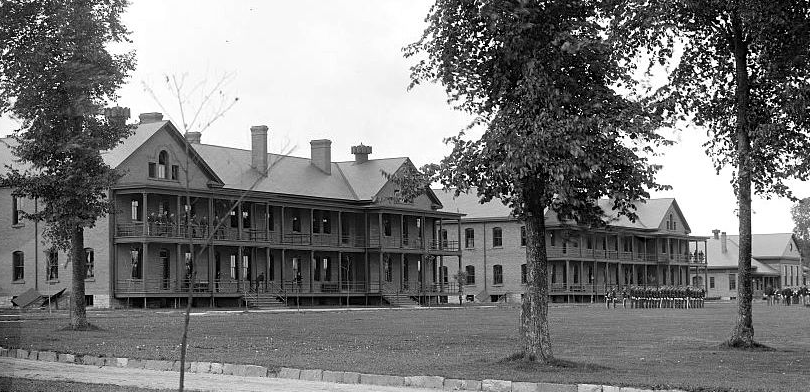
Brady, it was deemed advisable to find another location for the post. By Act of Congress, July 8, 1886, the Secretary of War was authorized to sell the old military reservation, purchase a new site, and erect proper buildings upon it. In the early nineties, General Sheridan selected the present location on the hill. The garrison occupied the new post in October 1893.
A part of the old reservation was sold in 1894, the present federal building lot being reserved and placed in charge of the commanding officer at Fort Brady. For years, it was a common, much as it had been in days of old. When Secretary of War Taft proposed to sell it, a vigorous protest on the part of public-spirited citizens resulted, and a second Act of Congress set it aside definitely for public building purposes. In 1908, Congress appropriated $150,000 for the present building, and two years later it was completed and occupied by the Sault Ste. Marie Post Office Force and other governmental departments.
Three complete post offices are maintained in Sault Ste. Marie, in the federal building on Portage Avenue, at Fort Brady, and at the ship canal. The latter is unique in that it was established for the benefit of the craft passing through the locks. It is open twenty-four hours a day during navigation, and tourists often avail themselves of its facilities.
The second great fire in August 1896, finished Water Street as the business highway of the city. The costliest building in the city, the Sault National Bank block, the Prenzlauer, Metzger, Perry, and many other buildings were destroyed. The historic Chippewa House went with the rest, part of it having been built sixty years before. Many present-day Saulteurs lost their business or office quarters in this fire, including Mr. Chase S.. Osborn, Mr. Otto Supe, Mr. E.S. B. Sutton, Mr. J. W. Shine, Judge Charles H. Chapman, Mr. T. E. Foard, and Mr. M. J. Magee. Ashmun Street and Portage Avenue succeeded Water Street as business centers, and their strategic location seems likely to maintain themselves in that position indefinitely.
Company G Organized
In the fall of the same year, Company G, Fifth Michigan Infantry, was organized in Sault Ste. Marie and many of the City’s finest young men enlisted in this volunteer militia company. The Armory was constructed in 1897, and weekly drills were held there. When war with Spain was declared in 1898, and President McKinley called for volunteer troops, Company G responded, and evolved as a unit into Company G, Thirty-fourth Michigan Volunteer Infantry.
The Company marched away to the war under the following officers: Robert S. Welch, captain; Henry F. Hughart, first lieutenant; Fillmore F. Scranton, second lieutenant; Wilfred T. Raines, first sergeant; Alford H. Colwell, quartermaster sergeant; Edgar C. Lemon, Edward M. Lacey, Fred H. Smith and John K. Dawson, sergeants; Albert H. Passmore, John A. Gowan, Wm. A. Goulding, Robert C. Sweatt, Leo P. Cook and George Stanley, corporals; Clement C. Wheeler and Eugene J. O’Neill, musicians; Thomas E. Roberts, wagoner, and Peter Murray, artificer.
Company G sailed in June 1898, from Newport News for Cuba, and was in service in the field until Santiago surrendered and after. Its members suffered severely with typhoid fever, malaria, and yellow fever, and several of them died of the effects of these diseases in Cuba and after their return. They were given a great homecoming welcome, but the rejoicing was mingled with sorrow over the ravages of disease and death. After peace was declared, Henry F. Hughart Camp No. 34, Spanish-American War Veterans, was organized here, its membership being composed of comrades who served both in the naval as well as the land forces of that war.
At the close of the century, the tiny village of Le Sault de Sainte Marie had progressed to city stature. It had passed from French to British domination, and thence to the freedom of the American government. The descendants of the ancient fighting Chippewa, once all-powerful here, saw the seat of their dominion transferred into a community eagerly striving to advance the arts of peace. Broad-visioned and history-making men had come and were at work, and with them came the assurance of prosperity and the realization of greater things.
The Soo – The Twentieth Century
When Mr. Francis H. Clergue first came to Sault Ste. Marie, he was about thirty-five years old. He had been sent as an expert engineer by a syndicate of eastern capitalists to examine and report upon the water-power possibilities of St. Mary’s River. Here he found Lake Superior, the globe’s greatest millpond, a narrow outlet with a fall of twenty feet or so, and raw materials abundant in quantity and variety.
Upon his recommendation, a company was formed which obtained from the Canadian Government a grant of nearly two million acres of land in Ontario. A large part of this acreage was covered with forests of pine, spruce, birch, maple, and oak. There were good prospects for iron, nickel, copper, and gold. It was the largest single tract of spruce timber in the world.
Gets Control of Sault Waterpower
Mr. Clergue secured control of the Canadian Sault waterpower, then dormant, and began a career of construction well-nigh unequaled on the continent. Besides the rapids on the Canadian shore, a pulp mill arose, one of the largest in the world and using fourteen thousand horse-power. Two railroads were built, the Algoma Central, extending northward from Sault Ste. Marie, Ontario, and the Manitoulin & North Shore, afterward the Algoma Eastern. More land was granted to the Company, which, under Mr. Clergue’s direction, uncovered great deposits of iron ore in the Michipicoten district; mined them, drained a lake, and built a railroad to Michipicoten Harbor; constructed ore docks there and began the shipment of ore. Blast furnaces followed at Sault Ste. Marie, Ontario, and in logical succession, machine shops and foundries, a rail mill, and car shops. Ships were brought to transport the Company’s ore and coal, docks were built in Sault Ste Marie, and a limestone quarry was developed in Mackinac County for fluxing purposes. The first rails made in Canada from Canadian ore were produced. A list of Mr. Clergues’ constructive activities in this region would fill a volume. Twenty-five million dollars were invested in the system created on both sides of the river, and all the units of that city dovetailed as it were into each other.
Canal Completed in 1902
The Michigan Northern water power canal and power house were completed under Mr. Clergue’s direction in 1902. Fifty-seven thousand horsepower were developed, and the canal created an island on which the main business section of Sault Ste. Marie Stands. The original project of extending the canal to a point below the Little Rapids was abandoned, and its course was shortened by a mile or more without loss of efficiency. Ownership passed into other hands, and the power developed is now used largely in the manufacture of calcium carbide by the Union Carbide Company. Its blue and gray drums are familiar throughout the earth, and its products are used by practically every railroad in the country for one or more purposes, by oxyacetylene welders and foundry men, miners, fire departments, physicians, and lighthouse tenders. Union Carbide affords a favorite means of lighting rural and suburban homes, schools, churches, and stores. It is uniquely used in Coast Guard life-saving equipment. Projectiles charged with Union Carbide are so equipped that gas forms and ignites when they strike the water. A brilliant and stray light ensues whereby rescues can be effected more easily and quickly than would otherwise be possible.
The powerhouse of the Michigan Northern Power Company is one of the most massive buildings in the United States, being nearly a quarter of a mile long, and constructed of stone blasted out in building the canal. On the occasion of its opening in 1902, a banquet was spread in the enormous building, and the city gave itself over to a holiday, while congratulations were showered upon Mr. Clergue.

- Dogs Pulled Heavy Loads - August 2, 2026
- Stones Contained Spirits - July 2, 2026
- Names Dreamed by Others - June 3, 2026


