
In 1923, Stanley Newton published “The Story of Sault Ste. Marie and Chippewa County.” This is part twenty-six of a continuing series about the history of Sault Ste. Marie and the area in its early years. I have left punctuation and grammar intact. – Laurie Davis
Mr. Fowle, chairman of the negotiating committee acting for local citizens, did not lose heart, however, nor did his associates. A period of fruitless bargaining with various promoters and capitalists followed, during which the local company reacquired title to the canal through foreclosure of the right-of-way bonds. Some wealthy New York and Chicago men proposed to complete the canal and construct big pulp and paper mills, but nothing came of it.
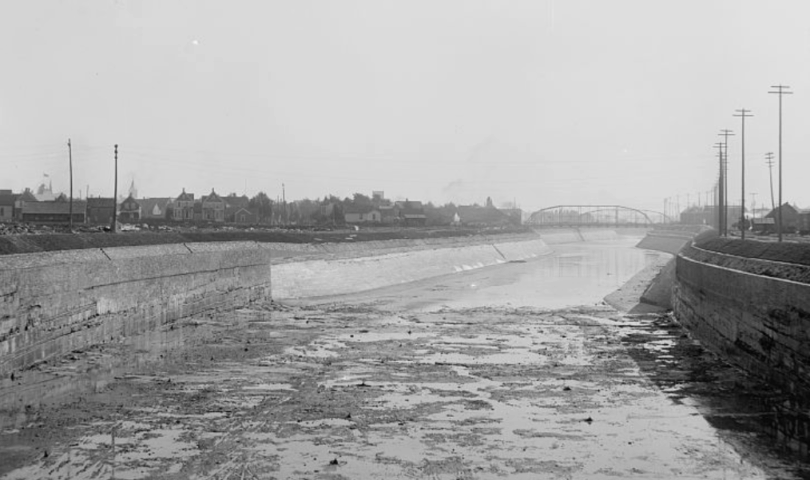
The climax of this story of alternate hopes and discouragements is told by Mr. Alvah L. Sawyer in his “History of the Northern Peninsula of Michigan.” “In 1893, there came to the two Saults a man of whom little was known. He had the appearance of a man filled with confidence and was inclined to say little. Little attention was paid to him, although it was known that he had been looking over a ditch in the Michigan Soo in which had been buried the hopes, money, and ambition of engineers, financiers, and the people of the two cities for nearly half a century. This was the Water Power Canal, and the man was Francis H. Clergue.
“It was not long before those who held the mortgages and the right of way of the canal were approached by Mr. Clergue with an offer to buy the rights and begin once more the development of this great water power, which had for centuries been running to waste over the rapids of the river. They were ready enough to sell, for they had lost all the money they cared to in the ditch, and they had no idea but that the newcomer was to do the same. Some laughed at him, while few ever dreamed of his success. But Clergue bought the ditch and went to work.
Canal is Completed
“Day after day the work was prosecuted, and year after year, until at last the people, even the most skeptical, began to see that they had now a man backed with plenty of money and filled with an energy which never knew the meaning of the word failure. At last, they saw the canal completed, and on October 25, 1902, the water was let in and the power turned on in the great house at the lower end of the canal. Then it was that the whistle cords were tied down on every whistle in the Soo, and the people of the two cities gave way to rejoicing, for they saw a new era of prosperity opened for them.” Thus, the vision of the people of the Soo, and of the ten citizens of ‘85 who set out to build a water power canal, materialized in a gigantic way, greater by far perhaps than they had pictured originally. Most of the ten lived to see their dream come true and to participate in its benefits, even though the project had passed from their hands. It was a mighty struggle, and at times an apparently hopeless one, but their faith conquered in the end, and the final outcome meant much to the city and to them.
Through the initiative of Otto Fowle and other progressive citizens, Sault Ste. Marie enjoyed the benefits of city water long before the power canal was completed. The community’s first waterworks system was a two-wheeled cart loaded with barrels and drawn by a pony. The water merchant drove into the shallows of the river on the present site of Brandy Field and filled and delivered his customer’s barrel for a quarter. The place was a favorite resort for the village cows, who came there to drink in the summer and to bury their flanks in the water, thus avoiding the flies. Frequently, the carrier filled his barrels when surrounded by cattle. It is recorded that many old inhabitants vigorously protested against a change in the methods of supply, saying that barrel delivery was good enough for them.
First Pumping Station
The first pumping station was erected a short distance west of the C.P.R. bridge, and water was taken a little way out in the stream. As the city grew, a change became inevitable, and the present station was built at the west end of Fourth Avenue, far away from any possible sewage contamination. With Lake Superior above, the greatest natural filter in the world, and the rapids below, forever drawing down fresh supplies and foiling all hazards of backwash, Sault Ste. Marie enjoys perpetual reserves of the finest drinking water to be obtained anywhere, always cool and sparkling clear.
Local Bank History
Mr. Fowle was one of the organizers of the Sault Savings Bank in 1886. Its first location was on the west side of Ashmun Street, near where Bacon’s drug store now stands. The bank occupied its present beautiful quarters in 1888. The present officers are: Mr. M.J. Magee, president; Mr. Henry Hickler, vice-president; Mr. Herbert Fletcher, cashier; Mr. Herman Taylor and Miss May Turner, assistant cashiers. Mr. Magee succeeds Mr. George Kemp, recently deceased, who was born and bred in Sault Ste. Marie. Mr. Kemp, an exemplary citizen and always loyal to his hometown, bequeathed to his city one of the most valuable dock properties on the Great Lakes.
The Central Savings Bank received its charter in 1902, Mr. R.N. Adams being its first president. In the same year, Mr. J. L. Lipsett, Mr. E.S.B. Sutton, and others organized the Chippewa County Savings Bank, which opened for business in the Brown Block on South Ashmun Street. Thus, the city had four banks at one period. Three years later, these banks consolidated in the Central’s location. Mr. J.L. Lipsett assumed the presidency of the combined institutions and has held that office since. The other officers are: Mr. C.E. Ainsworth, vice-president; Mr. A. Wesley Clarke, cashier; Mr. C.W. Swart and Mr. P.T. Wines, assistant cashiers.
The present officers of the First National Bank, originally organized by the private banking firm of Mead & Fowle in 1886, are: Mr. R.G. Ferguson, president; Mr. E.H. Mead, vice-president; Mr. Fred S. Case, vice-president and cashier; Mr. Otto McNaughton and Mr. Donald Finlayson, assistant cashiers.
These three strong banks have played a vital part in the upbuilding of Sault Ste. Marie and Chippewa County.
The Edison Sault Company
The beginnings of the electric lighting industry of Sault Ste. Marie were made in 1887, nine years after electric lights were installed in the capital building at Washington. The Edison Sault Electric Light Company’s powerhouse at that time was at the rapids’ edge near the present third lock. There was a considerable shortage of power at first, owing to the narrowness of the forebay and its frequent clogging with needle ice. The Edison Sault Electric Company succeeded the old concern in 1891, and in 1905, a new powerhouse was constructed well out in the river, thus ensuring power in adequate supply.
The teeth of the laughing tumbling rapids so admired by thousands have been drawn, and their countenance has been veiled by a compensating dam. Once a terror to the portaging voyageur, they work now, docilely and efficiently, for the modern Saulteur. They flood his streets and his home with light. They print his newspapers, propel his streetcars, and cancel the stamps on his outgoing mail. They sharpen the butcher’s knives and grind his sausage; they push up the elevators in our office buildings, and push down the dentist’s filling in our aching teeth. They furnish us grateful warmth in the evening, hot waffles in the morning, and ice cream for dessert. They curl Milady’s hair and sew her gowns. They melt limestone at 2,600 degrees Fahrenheit and freeze poultry at 20 degrees below zero. They spin a fragile electric fan or raise the ponderous leaf of a jackknife bridge with equal facility. They reach far out through Chippewa County and perform their wonders there. Truly, times have changed since the days of the ancient Chippewa who shot the rapids or their enemies with equal gusto.

- Dogs Pulled Heavy Loads - August 2, 2026
- Stones Contained Spirits - July 2, 2026
- Names Dreamed by Others - June 3, 2026


