

In 1923, Stanley Newton published “The Story of Sault Ste. Marie and Chippewa County.” This is part five going back to the beginning of the Sault, in a continuing series about the history of Sault Ste. Marie. Punctuation and grammar have been left intact. – Laurie Davis
Nothing could exceed the lightness and grace of Wabish’s canoes in the water, or their ease of carriage out of it. Each was:
Like a yellow leaf of autumn,
Like a yellow waterlily,
And the forest’s life was in it,
All its mystery and magic,
All the lightness of the birch tree,
All the toughness of the cedar,
All the larch’s supple sinews.
Wabish realized this, and gave great praise to Manibosho, who was the real inventor of the birchbark canoe and who bestowed it upon the Chippewas thousands of years ago. This act of invention he was able to visualize much more clearly after he visited Manitoulin Island, and saw there the very rocks between which Manibosho had built the first canoe and upon which he had hung it up to dry after pitching. Truly, Manibosho confirmed his friendship for the red man when he brought down the bark canoe. What other appliance is there that equals the bird in its swift flight over the water, that can be so easily transported around the portage or over the divide, or, turned bottom up on the beach, that affords so perfect a shelter when camping out on a rainy night?
You may be sure that when Wabish and his compeers went on a long canoe journey, a part of the outfit was a supply of pitch. When the Evil Spirits in the submerged rocks split the fragile bottom with a touch, the canoe was beached, unloaded, and reversed.Then the pitch was heated and poured over the crack in the bark until it was well sealed, upon which the voyage could be resumed in safety.
River Was a Delight
What a delight were the long, long, lazy summer days on the beautiful river! When the Hot Moon of June had come and gone, and the mosquitoes, black flies and no-see-ums had reveled in their brief day, then Wabish and his friends, bereft of all care and fancy-free, fared forth on the broad and placid bosom of their foster-mother.
The river we call St. Marys – it is really a strait – the Chippewas named Gitchi Gumi Sippi, the River of the Great Lake. They knew it for a powerful outpour of water dividing here and there into broad arms which separated, united, and divided again. Repeatedly these arms collected in large pools, almost lakes, dreaming calm in the summer sun; but these again shot in narrow passages from one lake to another, thus forming several rapids. And every passage was fringed and girdled by a maze of lovely islands, large and small.
Canoe voyages in this wild water labyrinth were exquisite indeed. The shores of the islands and mainlands were covered with dense forests of hardwoods and conifers, whose bright and dark greens met the eye in pleasing contrast. On the eastern side, the Algoma Mountains came down to meet the lake and halted there, having been torn away by Manibosho to give the mighty lake above a chance to breathe and to escape southward. These heights, too, were tossing with massed woods, but here and there the naked primeval Laurentian rock made hard faces at Gitchi Gumi Sippi and stuck its black tongues into the mocking stream.
It was a vast country, where distances were long, and where Nature performed on a big scale. Some of the islands in the river were as large as an English County. England itself could have been sunk in Gitchi Gumi without raising the water very much. And there were countless other islands as small as the floor of a wigwam, and in some places the roving Indians found themselves surrounded by tiny islets on which there was scarcely room for a tree.
In Primitive State
All these islands and shores were then in a state of primitive savageness. Their interior was uninhabited and uncultivated, and so covered with rocks and swamps, fallen trees and rotting stumps, that the bears could not wish for a better thicket. Even the nearest hilltops, protected by this tangled wilderness, had never endured the foot of man. The river’s easy highway led to many a hospitable beach, where fishing was good and an occasional runway brought the deer down to drink and be captured. Even as a youthful bowman Wabish could drive his flint headed arrows clean through the bodies of the flying deer.
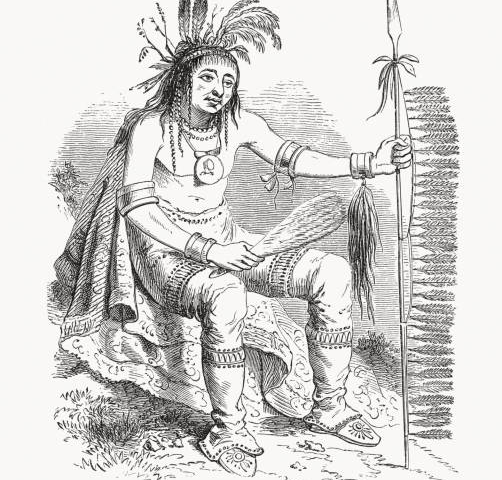
Oh ta gee zig, a handsome, burly Indian hereditary chief, who must have been about 30 years of age when Wabish was born, was the friend, hero and mentor of Wabish in his boyhood days. Oh ta gee zig had been born at noon, hence his name, meaning “half a day.” Once upon a time, Oh ta had strangled a bear with his two hands, a deed that won him great renown. On ceremonial days he wore twelve feathers in his hair. Each feather meant the death of a Sioux in battle. Oh ta was of the Owl totem, and his campfire on the river bank at Bowating was a favorite resorting place of the boy Wabish and his chums. Right cheerfully it burned of a summer evening, where the bicentennial monument stands now.
“Did you ever hear of the story of the first man and woman?” asked Oh ta of the group of Indians around his fire one evening. He was a famous story teller, especially when his pipe of kinnikinnick was drawing well.
Tell it to us,” said Wabish and his friend Ka ba konse, a brother of the Crane.
“You must know,” began Oh ta, “that Gitchi Manito, The Great Spirit, made first the land about Bowating and along the south shore of Gitchi Gumi. At first there was nothing here but sand and rocks, and the rapids were away up at Nad o way an ing, the Place of the Iroquois. This was long before Manibosho trapped beavers there.
The Chippewa Story of Creation
“One day Manito was walking along here when he saw something lying on the ground, and he picked it up. It was a tiny root. He wondered whether it would grow, and he planted it on the river bank, close to the water. When he came back next day a lot of shoots had sprung up, and the wind blowing through them made a pleasant sound. This pleased him, and he sought for and found more little roots and some seeds from the soil, and he spread them around, so that they soon covered the rocks and land with grass and fine forests, in which birds and other animals came to live. Every day he added something new to his creation, and he did not forget to place various kinds of fish in the water. But the best fish of all, the at ti ma kaig, the deer-of-the-water, the whitefish, came long after.
“Another day when Manito was walking near this place, he saw something coming out of the water, covered with glistening scales like a fish, but formed like a man. Watching it further, Manito saw it stoop and pluck herbs, which it swallowed. It sighed and groaned, but did not speak.
“The sight filled Manito with compassion and a good thought occurred to him. Immediately he set to work to provide this forlorn being with a squaw. He formed her nearly as he had seen the man to be and also covered her body with scales. Then he breathed a little of his life into her and set her feet upon the bank, telling her that if she would walk along the shore and look about her she might find something to please her.”

- Opinion: Let’s Take Back Control of our Country - October 10, 2026
- He Discovers the Woman - October 3, 2026
- Canoes Light and Graceful - September 1, 2026