

LANSING– The Sault Ste. Marie International Bridge and the Blue Water Bridge are major connections for both tourism and international trade between the United States and Canada.
Since 2025, these bridges have seen a shift toward fewer passenger vehicle and truck crossings, which experts say result largely from higher tariffs and anti-U.S. sentiment by Canadians after President Donald Trump’s remarks critical of their country.
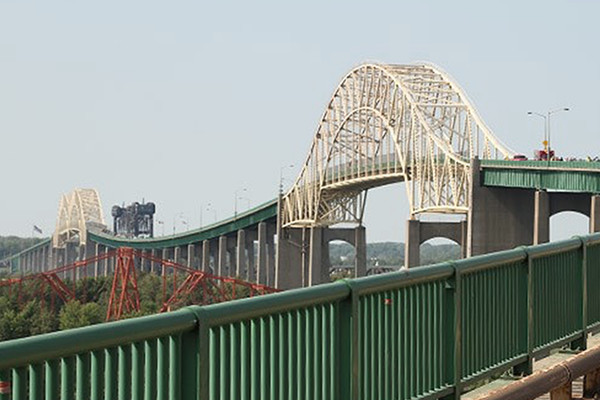
The International Bridge serves as the connector between the Upper Peninsula and northern Ontario. It runs between Sault Ste. Marie, Ontario, and Sault Ste. Marie, Michigan.
The Blue Water Bridge runs between Port Huron, Michigan, and Sarnia, Ontario, connecting Southeast Michigan and lower Ontario.
The International Bridge saw a decrease of 9,781 total vehicle crossings in just one year – going from 575,998 between January to August 2025 to 566,217 for the same period in 2026.
Those numbers include both passenger vehicles and commercial trucks, buses and other types of vehicles.
Data shows passenger vehicle crossings alone are down 23% when comparing the first eight months of 2026 to 2024.
The Blue Water Bridge is a much busier point for tourism, international trade and travel.
More than 1.4 million commercial trucks crossed there from January to August 2025. For 2026, the number was 1.2 million crossings, a dip of 14%.
Meanwhile, the Sault Ste. Marie bridge handled 42,365 truck crossings from January to August in 2025 and only 36,716 in those months this year.
Steven Melynk, a supply chain and management professor at Michigan State University, attributes the declining commercial and passenger traffic to political tension and tariffs.
“The direct evidence at these two crossings already shows real financial and staffing effects,” Melnyk said. “The mechanics of how toll-funded bridge authorities work point to a fairly predictable chain of further consequences if the decline persists.”
Melnyk estimates that the Sault Ste Marie area lost $82.9 million in local spending by travelers last year alone.
Losing toll revenue can pose problems for the state and province, such as less future funding.
Melnyk said most international bridge authorities are funded substantially or even entirely through toll revenue.
The International Bridge is completely self funded by tolls while the Blue Water Bridge relies primarily on tolls and some government grants.
Some bridges have increased toll prices.
According to the Blue Water Bridge website, its toll prices increased by $1 in U.S. dollars and $2 in Canadian dollars in December of 2025. The International Bridge introduced a system that will gradually raise prices for consumers from today’s $4.60 in U.S. dollars to as high as $7 in U.S. dollars in 2033.
In the Metro Detroit Area, the privately owned Ambassador Bridge saw truck traffic increase to about 1.3 million in the first eight months of 2026, up about 8% from the same period in 2025. Passenger vehicle traffic, though, dropped by 4.4% in that time, according to the bridge’s website.
The new Gordie Howe Bridge between Detroit and Windsor, Ontario, opened in July so there is no comparable data from prior years.

- Senators from both parties voice criticism about Pentagon briefing on US defense strategy - September 19, 2026
- Bridges in Port Huron, Sault Ste. Marie see dips in traffic due to friction with Canada - September 19, 2026
- Child found in Marquette County after search effort - September 19, 2026