

KALAMAZOO, MI — Scott Lacey doesn’t want to be viewed as an inspiration.
He wants the world to think differently.
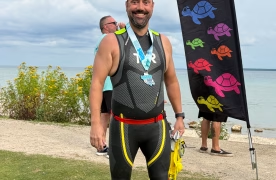
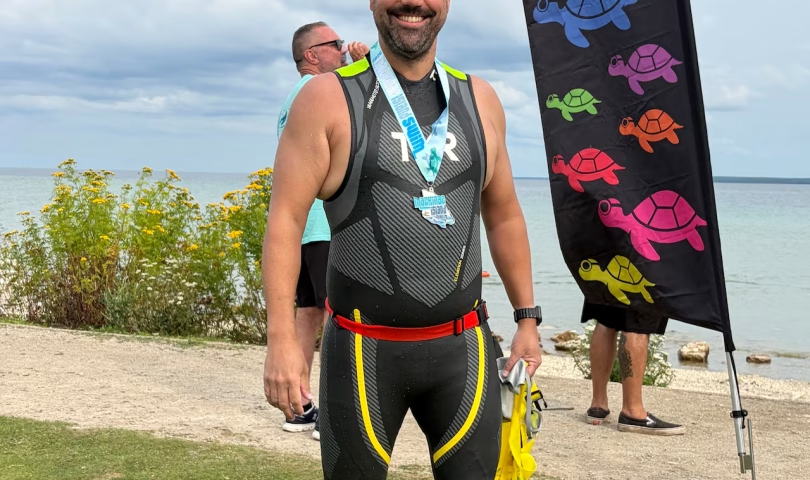
On Aug. 9, the Kalamazoo athlete gave people another reason to do exactly that, becoming the first known visually impaired athlete to swim around Mackinac Island, navigating the waters around the island’s 8.2-mile perimeter for more than nine hours.
The feat took countless hours of training, a carefully planned support system and relentless determination. White Lacey, 43, admits the accomplishment was empowering, he still hesitates to call it inspirational.
“I’d like people to move in a direction where the expectation isn’t that a person with a disability can’t do it,” Lacey said. “The expectation is they can do it. They just might do it a little differently.”
For Lacey, the historic swim is simply the latest chapter in a life shaped by adversity and a refusal to let it define him.
Shaped by adversity
Born with hydrocephalus, a condition defined by an abnormal buildup of cerebrospinal fluid inside the brain, Lacey underwent surgery at just a year old to have a shunt — a surgically implanted medical device — implanted to help regulate fluid around his brain.
The device was a success for decades, allowing him to live a normal life that included varsity sports such as soccer and tennis at Holland West Ottawa.
“I was always the person that told myself that I was going to be faster than you and more fit than you,” said Lacey, a 2001 graduate from West Ottawa. “I might not be the best, but the things I can control, I’m going to control to the best that I can.”
Then, in 2009, everything changed.
What began as headaches and occasional blurred vision quickly became more serious, as a daily commute to work changed everything. Lacey’s world suddenly turned pitch black.
“I was driving to work one day and lost my vision,” Lacey recalled.
A failing shunt had allowed pressure to build so quickly that it crushed his optic nerves. Within hours, he was undergoing emergency brain surgery, but the damage was permanent.
The setback has since left him with more than 20 additional brain surgeries and numerous complications — including infections and hospital stays that last up to six weeks.
“I’ve had a lot of life circumstances that have affected me and asked, ‘How are you going to move forward?’” Lacey said.
Those challenges extended beyond his health. Lacey endured the loss of both parents at age 4 and the destruction of his childhood home in a fire.
Yet when he reflects on the challenges he’s faced, he doesn’t want to focus on what was taken away.
Instead, he focuses on what comes next.
“There is significantly more that you can do than you can’t do,” he said. “If it’s something you really want to do, the first step is figuring out how it can be possible.”
‘Impossible doesn’t exist’
That approach shaped the years that followed.
Shortly after Lacey lost his vision, he started becoming active. He began walking on a treadmill to manage anxiety before those walks became runs, and those runs grew into endurance races.
His mindset transformed what was feasible — first he conquered the Boston Marathon and followed it up with Ironman triathlons.
“It was me wanting to internally prove to myself that I could do it,” he said.
Along the way, Lacey developed a personal mantra.
“Impossible doesn’t exist,” he said.
“If you want it bad enough, you’ll find out how to get there. Sometimes it’s not comfortable. Sometimes it’s exceptionally challenging. But usually, I can figure out a way to get to the finish line.”
That mindset has fueled much more than athletic accomplishments.
Lacey believes society often places unnecessary limits on people with disabilities, and he hopes his story helps challenge those assumptions.
“People with disabilities can do anything anybody else can do if they’re provided the right opportunity,” Lacey said. “We may do it slightly differently, but it doesn’t mean a person can’t do it.”
That’s a message he really wants to drive home to youngsters, particularly those facing their own obstacles.
“If it’s something you really want to accomplish, start figuring out how it can be possible,” he said.
Because adversity, he said, is universal.
“You’re going to get knocked down,” Lacey said. “I don’t know anybody that hasn’t been knocked down in their life. It’s more about how you’re going to pick yourself up.”
The record-breaking swim
Then came the idea of conquering Mackinac Island. It emerged through his longtime connection with Mackinac swim director Jon Vos, who grew up in the same neighborhood as Lacey.
Lacey swam throughout his childhood — and the thought of swimming around the island was not only intriguing but motivating considering the circumstances.
If achieved, Lacey would make history.
“I’m not going to say being the first person to ever do it wasn’t a motivator,” Lacey admitted. “Because it was.”
That meant months of training at Bronson Athletic Club in Kalamazoo. He began swimming in half-hour intervals before reaching five hours ahead of his 8.2-mile journey up north.
He also developed a plan that included creating a specialized tether system that connected him to a guide swimmer during the race, using assistance from ChatGPT.
When race day arrived, Lacey entered the water tethered to a guide swimmer he had only met one day earlier. The first few miles saw challenges, battling through changing conditions.
Soon enough, though, they found a rhythm.
“The further we went along, the more confident I got,” Lacey said.
Lacey said he used a company called Infinite Nutrition to receive fuel in the form of custom-blended drinks, giving him all the nutrition needed to conquer the swim.
Nine hours later, he climbed out of the water having accomplished something nobody before him was known to have done.
“It feels good,” Lacey said. “Absolutely exciting and empowering, maybe, would be a word. And relief that, hey, I actually did it.”
Already looking ahead
The Mackinac swim is just the beginning for Lacey.
He’s already in the works to run it back next year, this time completing the swim without a wetsuit in pursuit of an official open-water record and a significantly faster time.
He’s had discussions about a larger open swim, too, such as swimming across Lake Placid or Lake Tahoe.
For Lacey, the next test isn’t just an opportunity to be bold, nor is it about tackling one single accomplishment. It’s about challenging assumptions.
And showing others what’s possible.
“Resiliency is something I’ve built over years and years,” Lacey said. “I want to show people that if you put a goal out there, you can absolutely do it.”

- ‘Impossible doesn’t exist’: Michigan man becomes first blind swimmer to lap Mackinac Island - September 17, 2026
- U.P. lawmakers call on Legislature to pass MDOC officer pension bills - September 17, 2026
- Missing 6-year-old found safe with dog after hours-long search in Upper Peninsula woods - September 17, 2026