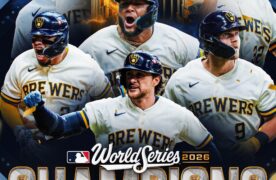


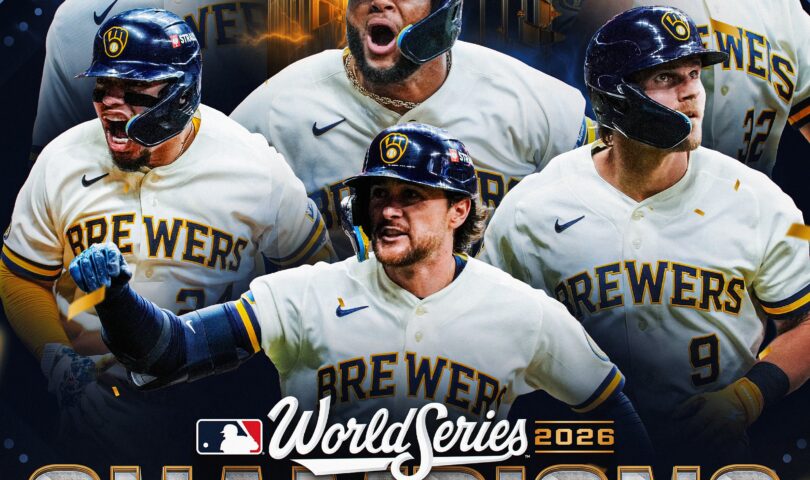
ST. PETERSBURG, Fla. – The 2026 Milwaukee Brewers are a baseball MasterClass, a near-perfect combination of high-end pitching, elite swing-decision, high-contact offence and hit-stealing defence, each roster piece optimized, all infused with a relentless tenacity.
They stomped the National League during a 103-59 regular season, dispatched the San Diego Padres in a tight division series, swept the two-time champion Los Angeles Dodgers in the LCS and then wore out the American League’s best team, overwhelming the Tampa Bay Rays in five games capped by Wednesday’s 4-1 victory to secure the first World Series title in franchise history.
Wire-to-wire, that’s 114-61, remarkable .651 baseball and talented as other clubs might be, there’s a significant gap between them and the new champs. The Rays, with ace Drew Rasmussen starting on short rest, had hoped to draw life from Tuesday’s riveting 4-3, 12-inning comeback win, but like a chain-link fence trying to hold back surging waters, they were powerless to contain the flow.
“I’m just really, really grateful, really thankful that we did it,” said manager Pat Murphy, who established the standard of relentlessness his team made a feature. “Like, who believed it? There are so many things that led up to it now that I look back and see the years of getting eliminated or being beaten last year by the Dodgers, that was a blessing because we learned from it and we grew, and we came in with a different attitude.
“We came in with a spirit about us, and we weren’t going to be denied.”
Cooper Pratt, the rookie sensation whose 12th-inning homer a night earlier nearly became part of franchise lore, opened the scoring with an RBI single in the second, came around on David Hamilton’s base hit in the fifth and added a sacrifice fly during a two-run sixth, while triple-digit-velo wonder Jacob Misiorowski shoved for 5.2 innings before leaving with a right calf cramp.
The bullpen took care of the final 3.1 frames, and they celebrated accordingly at Tropicana Field, where at least a third of the 40,489 in attendance were Brewers fans who took over the place and didn’t want to leave. Hundreds of team employees flown down for the games lingered on the field hours after the final out, relishing a title 58 years in the making.
“People like Robin Yount, Bob Uecker, Bud Selig, there are people that have carried the torch here for a very, very long time,” said president of baseball operations and general manager Matt Arnold. “They celebrate the heck out of the 1982 team (that lost the World Series in seven games to St. Louis), rightfully so, but they have wanted a World Series here for so long, and this is so special to so many people.”
Added World Series MVP William Contreras: “Very blessed year.”
There’s good reason for all baseball fans to wish the moment wouldn’t end, given what lies ahead for the sport.
Off-season business begins Thursday and it will be a sprint under a countdown to the owners’ lockout of players once the collective bargaining agreement expires Dec. 1. What’s shaping up as a dark and protracted labour fight will freeze all winter activity in the industry and, with sides firmly entrenched in their position, the league determined to implement a salary cap, the union vehemently opposed, the possibility of lost games for the first time since 1994 is very real, possibly even inevitable.
“To be honest, we’ve just been focused on the World Series,” said Brewers captain Christian Yelich. “Obviously there’s going to be a lot of talk this off-season about what’s going to happen. … I think the game’s in a great spot right now with a lot of people tuned in, a lot of popularity, a lot of great players out there. It would obviously be a shame if we miss time, but we’ll have plenty of time this off-season to talk about it.”
What the economic system looks like whenever play resumes is already factoring into the thinking of various front offices, who are bracing for a flurry of activity, particularly at the top of the free-agent market, before the cutoff. At the same time, they’re remaining wary of positioning themselves poorly for what could be a more restrictive framework for 2027 and beyond.
Regardless, the Brewers, with a projected Competitive Balance Tax payroll of $154 million that ranked 20th in the majors, and the Rays, 28th at $110 million, showed what’s possible without the largesse of the Dodgers, far and away the game’s top spender at $422 million.
What teams take away from that won’t be uniform – on the one hand, sure, small markets can have championship aspirations; but maybe also, medium to large markets are better off spending smarter rather than more. Same goes on the baseball operations side, when examining the pathways to victory for both World Series finalists.
“Hopefully they take nothing,” Arnold said with a laugh. “I would say a lot of heart, man, and I know that’s hard to measure because everything we do in this era is something that we measure. You can’t measure the heart of this team.”
That’s a byproduct of their player-acquisition process, which has become a separator between them and rival clubs. In trying to identify players to fit their identity, “I try not to overthink it,” said Arnold. “Just find good players and make sure they’re good people. That’s a pretty good formula.”
On the offensive end, the Brewers’ tenacity in the box and chaos-making ability on the bases was no doubt enviable and admirable, but the Toronto Blue Jays and Dodgers employed similar qualities in an all-time Fall Classic a year ago, and teams would gladly take the extra power both featured.
The speed of both Milwaukee and Tampa Bay, combined with their on-base skills, creates opportunities to score runs and the pressure they put on can get their batters pitches to hit since pitchers have more to manage. And the Brewers especially were locked in to their approach all year long, creating a defined identity for a roster able to carry it out.
“The approach for us is really just put together a good at-bat, know what you’re looking for, when you get to two strikes, just battle, have a good at-bat for the next person, and hopefully the next person has a good at-bat, so on and so forth,” said Hamilton. “You just put together good at-bats back-to-back, and it wears on the pitcher, wears on the other team, and it gives us good pitches to hit, too.”
Added centre-fielder Garrett Mitchell: “We’re the type of team to step on teams’ throats and keep going. We’re relentless. We don’t stop. Especially this time of the year, you never want to let anyone even have a sliver of a chance if you don’t have to let them.”
The Blue Jays, of course, said similar things a year ago and lost it amid injury and underperformance this year, underlining how fickle offence can be year-to-year.
In spite of that, Rasmussen said the type of “baseball that both sides play, I do think you can replicate it,” but “it’s the natural ebbs and flows of how this industry works, where we kind of go on 8-to-10-year stretches of one way of winning is predominantly what everyone’s trying to do. For the last decade or so, it’s been, can we hit the long ball and strike people out on the mound. … Now I think you’re just starting to see it swing back in the other direction.”
Trend or not, both teams featured the kind of pitching depth other organizations can only wish for and the wisdom to deploy it effectively and creatively. The Rays were more top-heavy with starters, while the Brewers relied more on their bullpen, even with Misiorowski at the front of their staff. He led them in post-season innings at 19, one more than reliever Aaron Ashby’s 18 over nine games.
“What has stood out to me … most probably is the quality of their at-bats,” said Rays manager Kevin Cash. “The other thing that has stood out is obviously the power that comes out of their bullpen. They’re quality pitchers with quality stuff and they’re filling up the strike zone.”
Canadian Jim Henderson, the Brewers pitching co-ordinator, is responsible for helping map out game coverage, something the club must do well to succeed. In Game 4, they used eight pitchers, beginning with three innings from Dustin May, one from JoJo Romero, two from Abner Uribe, five outs from DL Hall, one from Trevor Megill, seven outs from Ashby and two from Antonio Senzatela, before Shane Drohan allowed the walk-off hit at the end, but Misiorowski helped them reset in the finale.
“We have the pieces to do it,” said Henderson. “To be able to use guys like JoJo Romero and DL Hall and Dustin May early in the game, I don’t think many teams have that fortune to use those fellas, and then also have the back-end guys still ready to go. In a sense, you can do a bullpen game almost any day with our group and it’s kind of what we’ve done all season, and we’ve operated that in the last few years.”
Tying it all together is the type of cohesiveness and belief all teams at this level require, forged early in the season by some comebacks that became a norm and turned into a characteristic.
“We were bouncing back constantly. We were always in the game. We were fighting back,” said Brice Turang. “You really started to see it and be like, man, this team, we can do this. Then you believe in it, and you go from there. The more you see it, the more you believe it. Man, the trust that we have in each other, it’s awesome.
“That’s why we’re here where we’re at. We trust each other, we believe in each other.”
Thirty teams tried, one succeeded better than all. The Brewers are deserving champions at the end of a great season that heralds an uncertain labour future.

Feel free to provide your teams sports scores and roundup to sports@eupnews.com when your game is completed.
- Congratulations, Milwaukee Brewers: World Series Champions! - October 29, 2026
- Voodoos rally for shootout win over Eagles - October 25, 2026
- Gold Miners get home win over Eagles - October 25, 2026