


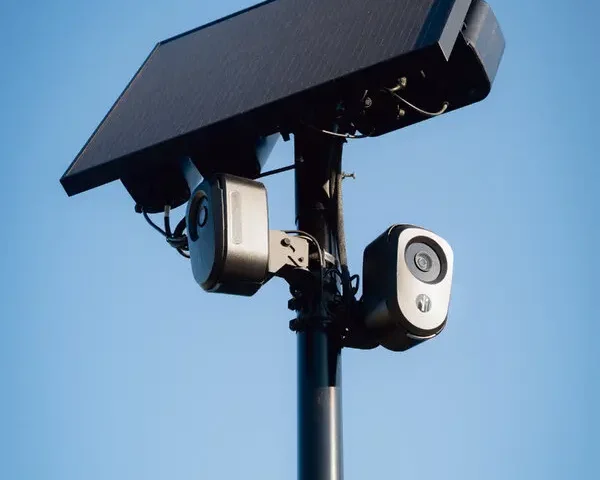
LANSING, Mich. (News 10) – A Michigan state senator has introduced legislation to limit the use of automatic license plate reader cameras, which have drawn privacy concerns from the public even as law enforcement agencies say the technology has proven effective.
State Sen. Jim Runestad (R-White Lake) introduced the bill, which would require a warrant before the government could access an automatic license plate reader’s database — unless an active criminal investigation, missing person case or stolen vehicle investigation is underway. The legislation would also require license plate data to be deleted after 14 days, down from the 30-day retention period common among many law enforcement agencies.

In a release, Sen. Runestad said:
“Passively collecting information 24/7 as people go about their daily lives is a drastic overreach and goes well beyond public safety needs. This legislation acknowledges that certain emergency situations can be greatly assisted by this technology, but sensible safeguards need to be put in place…We want to strike a balance between dystopian overreach and keeping our communities safer by providing law enforcement with additional tools to catch criminals.”
According to the American Civil Liberties Union, between 80,000 and 100,000 Flock cameras are installed across the country, performing more than 20 billion scans each month.
Jackson County Sheriff Gary Schuette said the cameras have been an effective tool, particularly for recovering stolen vehicles.
“We’ve recovered a number of stolen vehicles using the flock camera system, because frankly, it’ll pick up on a stolen vehicle and give us an alert that a stolen vehicle has just passed it,” Schuette said. “Then we can go into that area and locate that vehicle.”
Schuette said he believes the proposed 14-day data hold is too short for investigations and that he hopes the current 30-day window can be maintained, giving police the ability to review previous criminal activity. He said, however, that if 14 days is what the state determines to be appropriate, his agency will follow the regulations.
Schuette described the technology as a limited data collection tool. “Flock camera system is a snapshot in time of a license plate, and that’s it,” he said. “We hold that snapshot for 30 days and then it’s released.”
John Warmb, of the advocacy group DeFlock Lansing, said the cameras go beyond simple snapshots.
“Flock cameras are used to basically establish what they consider a vehicular fingerprint for every passing vehicle, again, without a warrant and add it to an AI-powered database,” Warmb said.

Warmb also described the broader concern with the technology. “It’s a surveillance dragnet that is monitoring the behavior and motions of every citizen,” he said.
Lewis Langham, a Professor Emeritus at Cooley Law School and a retired detective Lieutenant with the Michigan State Police, says while he understands privacy concerns from the public, he says cameras are already up across the country; these are just a different type.
“There are cameras everywhere you go, parking lots throughout every state, parking lots; there’s cameras everywhere. You pull up to a drive-through window. So, law enforcement are saying cameras are catching people everywhere all the time, and they say this is just an extension of that, but the purpose that they’re using it for is to help track down people that are preying on other individuals as well as auto theft, as well as looking for individuals that have just committed a crime.”
He says the question from the general public comes with “how it’s being used and/or retained.”
Runestad said his bill strikes a balance between protecting privacy and allowing police to continue using the technology. The Senate legislation is an answer to two similar bipartisan House bills that have been in committee since February.

- Athletics player sues Detroit Tigers for physical damage sustained during a game - September 29, 2026
- Gaylord School Community Reponds to Threatening Song - September 28, 2026
- Attorney General debate centers on Line 5 arguments, attacks on record - September 28, 2026