

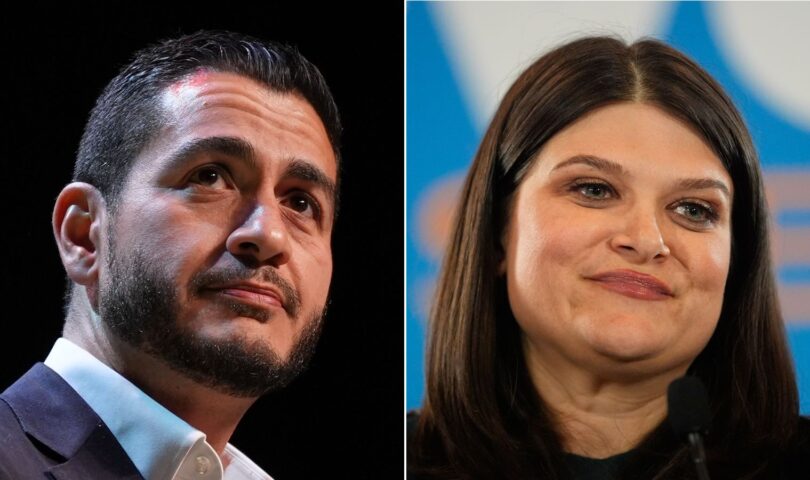
UPDATE: The Associated Press has declared Al-Sayed the winner of the Michigan Democratic Primary for US Senate against Haley Stevens.
Original Story:
The Democratic primary for Michigan’s Senate seat hung on a razor’s edge early Wednesday, with the unresolved race becoming the latest and most dramatic example of a lingering divide over political tactics and progressive ideology as the party seeks a path back to power.
During much of the Trump era, Democratic primary voters have often followed the urging of party leaders and favored moderate candidates like U.S. Rep. Haley Stevens. But this year, they’ve veered toward insurgents like Abdul El-Sayed, who tapped into widespread discontent with the Democratic establishment and the status quo in Washington.
The race was too early to call after midnight Wednesday with only a single percentage point separating the two candidates.
Democrats need to rack up as many wins as possible to take back the U.S. Senate, so the party has little room for error against the Republican nominee, former U.S. Rep. Mike Rogers.

Republicans faced their own test in Michigan in the governor’s race, where President Donald Trump’s handpicked candidate, U.S. Rep. John James, defeated Perry Johnson, a wealthy, free-spending outsider.
More primaries were taking place in Kansas, Missouri, Virginia and Washington. The contests will solidify November matchups, particularly in Virginia, where Democrats failed to redraw the state’s congressional map earlier this year.
Here are some takeaways from Tuesday’s elections:
The choice between El-Sayed and Stevens has become a focal point for Democrats this year, and the race has become bitter. Whoever wins will need to bring splintered factions back into the fold to beat Rogers.
Speaking at her election night party as votes were still being counted, Stevens looked ahead to the general election and said voters had to be ready to take on Rogers in the fall. El-Sayed, speaking at his own event, said that there was “so much more that unites us.”
“Tomorrow we begin to mend fences,” El-Sayed said.
The seat is open because Democratic Sen. Gary Peters is retiring, and Democrats are under pressure to defend it to preserve their chance of winning control of the chamber.

The campaigns have taken sharp aim at one another. Sen. Bernie Sanders, one of El-Sayed’s most prominent supporters, called Stevens “nothing more than an employee” of billionaires. El-Sayed has been a pointed critic of Israel and called the military campaign in Gaza a “genocide,” an accusation rejected by the Israeli and U.S. governments.
Stevens has criticized El-Sayed’s style, comparing him unfavorably to a celebrity who is always “running at the first mic or camera.” She has also suggested he’s not electable in the fall, saying Republicans have been propping him up because they think El-Sayed will be easier to beat.
Republican voters picked their nominee for Michigan governor on Tuesday as well, going with Trump’s endorsed candidate, Rep. John James.
The president’s backing typically carries significant weight in Republican politics, but businessman Perry Johnson had lent his campaign more than $30 million, according to Michigan campaign finance records.
Trump’s endorsement hasn’t always overcome big spending. In Georgia’s race for governor, Rick Jackson spent $100 million, largely of his own money, to defeat Trump-backed Burt Jones in a runoff.
On the Democratic side in Michigan, Secretary of State Jocelyn Benson defeated Genesee County Sheriff Chris Swanson.
The American Israel Public Affairs Committee has long been an influential force in U.S. politics, but it’s been under pressure as Democratic support for Israel erodes over the war in Gaza.
The organization has suffered a series of losses in Democratic primaries that saw a surge of progressive candidates. Victors range from Rep. Analilia Mejia, who won a special election to Congress in suburban New Jersey, to Evanston Mayor Daniel Biss, who captured the Democratic nomination for a U.S. House seat in Illinois.
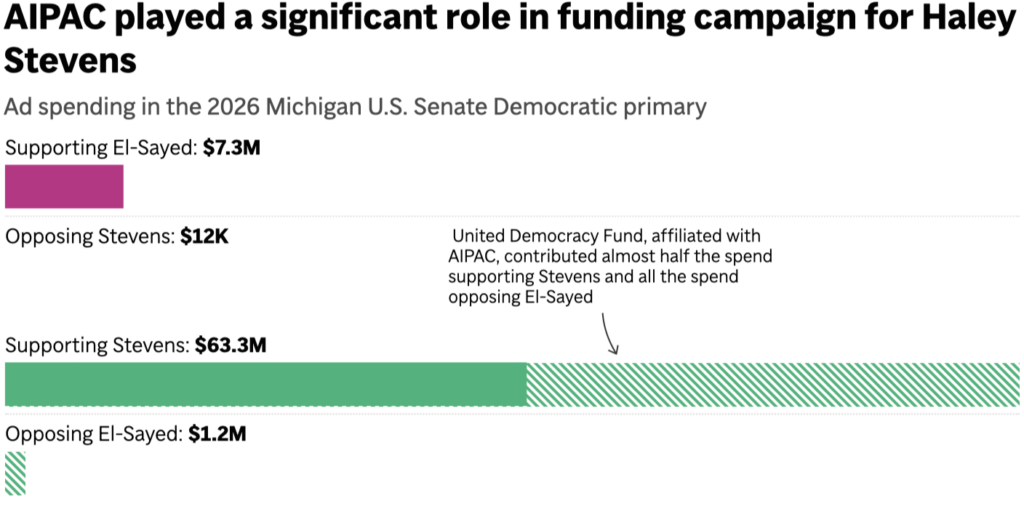
AIPAC’s biggest investment has been in Michigan, where it and its affiliates have spent more than $30 million supporting Stevens, a stalwart backer of Israel. El-Sayed and his backers have seized on the group’s intervention as an example of the problems of big money in politics.
Although the outcome in Michigan remained uncertain, AIPAC had some success Tuesday. In Missouri, former Rep. Cori Bush fell short in her rematch against Rep. Wesley Bell, who defeated her two years ago.
Bush had blamed her previous loss on AIPAC, even vowing revenge on the organization in her concession speech. “AIPAC, I’m coming to tear your kingdom down!” she pledged.
However, she was quickly defeated as voters in the St. Louis-area district decided to stick with Bell.

- ICE agent shoots and wounds man in Austin, Texas, officials say - September 21, 2026
- MS NOW, CNN and Politico say their journalists were denied access to White House after Trump ban - September 20, 2026
- Trump targets more news outlets, saying he will ban CNN, MS NOW and Politico from the White House - September 19, 2026