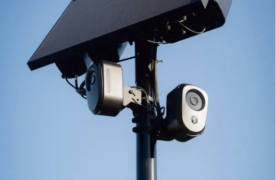


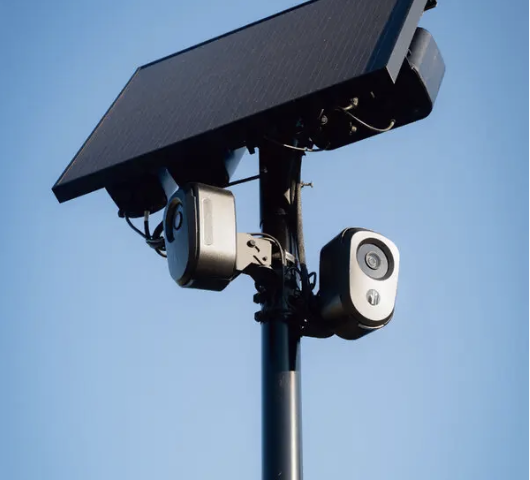
Michigan’s gubernatorial candidates both addressed a topic on Wednesday that’s quickly become the talk of small towns across the U.S. and viral social media comment sections alike: the nondescript black cameras owned by Flock Safety, Inc. that many Americans have become suspicious of as local policing embraces artificial intelligence.
Flock cameras, as they’re colloquially called, have drawn reactions ranging from confusion to angry public comments to graffiti and forcible “de-Flockings” (the rogue removal of a camera from its perch, typically on a black post along a roadway or in a parking lot) as members of the public learn more about the contracts their local governments and law enforcement agencies entered into with the company, frequently without oversight.

What sets an automatic license plate reader like Flock cameras apart is artificial intelligence: AI is used to capture and analyze images of any number of vehicles passing the camera, and its software stores details including a car’s make, model, color, identifying marks or features and notes the image’s location, date and time.
Law enforcement agencies have said the cameras are invaluable for tracking down suspected criminals, giving local police departments access to a data system of millions of vehicles to compare against information gathered when a crime occurs. Opponents of the cameras, though, say the stored data points of those vehicles constitute a Fourth Amendment violation when the information is held regardless of whether the driver is suspected of a crime and without a warrant.
Florida became the first state in the U.S. officially ban the use of Flock cameras as traffic enforcement on state roads on Tuesday, when the state’s department of transportation issued a memo informing local police departments it was “revoking all previously issued approvals for license plate readers in state rights-of-way.”
The cameras have become a common sight in parking lots and along roadways across the country and have prompted questions about privacy and data security, particularly as stories surface of law enforcement officers being arrested for misuse of the camera surveillance systems to stalk former romantic partners, relatives or acquaintances.
Michigan isn’t new to fights over Flock: in Menominee, the city council voted unanimously in May to cancel the city’s contract with the company after its cameras were reportedly activated without authorization from local leaders. Lansing adopted a resolution at a recent city council meeting to end all contracts with Flock. Westland will not renew its Flock contract after community pushback and Bay City voted against a contract with Flock after a public input process yielded community concerns about privacy.
All of these instances are listed as “victories” on the website of DeFlock, a volunteer-driven tracking project for automated license plate readers around the U.S. and other parts of the world. DeFlock operates a live map tracking existing Flock cameras and other ALPRs as well as a database of jurisdictions that have taken steps to regulate the devices.
In 2022, Ypsilanti was ahead of much of the public sentiment and buzz regarding Flock cameras when it banned all automated license plate readers, citing privacy concerns. It remains one of the earliest “wins” listed on DeFlock’s web page.
Although the Flock issue has so far been largely decided at the local level, Florida’s decision marks a new frontier for states looking to take a more uniform approach to the surveillance method. Michigan’s next governor may be the one to undertake a similar action.
Republican gubernatorial candidate John James was asked about his stance on the cameras during a Wednesday morning press conference. He said the Fourth Amendment “is not negotiable” but noted the benefits the cameras have had for law enforcement.
“Well, balance is the key approach. Our Bill of Rights, our Fourth Amendment, our right to privacy is not negotiable, but we also need to make sure that we are working within the Constitution to keep innocent people safe and put bad actors away,” he said. “So again, the Bill of Rights and our right to privacy is non-negotiable, and I’ll be doing everything that I can to protect the privacy of Michiganders and also enforce the law.”
Democratic gubernatorial candidate Jocelyn Benson issued a statement on the matter later on Wednesday, saying Michiganders “deserve to know when government is collecting information about them, where that information goes, and who has access to it.”
“Right now, we’re not getting that basic transparency. I hear from people across Michigan who drive past a Flock camera every day and have no idea what happens to that picture after it’s taken: who sees it, how long it’s kept, or whether it’s shared with agencies they’ve never heard of,” Benson said in the statement. “As Governor, I’ll stand up to anyone who tries to take away your privacy. I’ll work with the legislature to pass clear rules for how these cameras are used, who can access the data, when it can be shared, and when it must be deleted. We can protect public safety and personal privacy when government is transparent about how it uses technology and is accountable for the power it has.”

Benson said despite what he may say, James won’t be able to truly protect the privacy of Michiganders if he’s elected governor because of his allegiance to President Donald Trump, who has been the recipient of sizeable donations from tech CEOs.
“John James can’t say he’ll do the same when he’s beholden to Donald Trump, who has over and over again tried to use Michigan citizens’ private information against them,” Benson continued. “Michiganders deserve a governor who answers to them, not someone who will bend the knee to Big Tech donors or the President of the United States. I know who I answer to: the people.”
Michigan could pursue a similar regulation of Flock cameras to Florida’s at the state level by regulating ALPRs on state rights-of-way. The Legislature could also look to force disclosure of ALPR data or require its deletion after a certain amount of time – similar legislation has been introduced in other states, but none has seen passage yet.

- Sault High Hall of Fame Spotlight – Tracy McDonald Holt - September 3, 2026
- I-75 resurfacing in Cheboygan County starts Sept. 8 - September 3, 2026
- Upper Peninsula Arts & Culture Alliance to Host 2026 Annual Conference in Sault Ste. Marie - September 3, 2026