
As voters consider who should fill Michigan’s open US Senate seat, there are several big policy issues for candidates to address: What is the future of health care? What to do about high costs of living and affordable housing shortages? Should the rules around money in politics be changed?
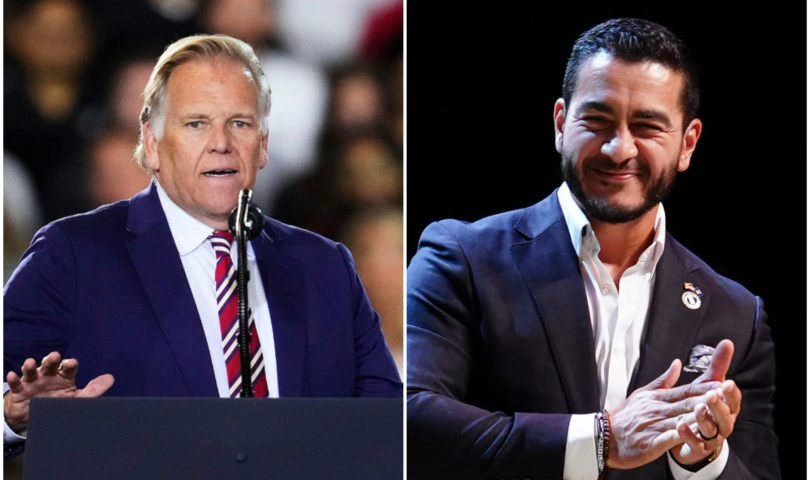
In the closely watched and nationally consequential tossup race between former US Rep. Mike Rogers and former public health official Abdul El-Sayed, the candidates’ backgrounds, past and present associations with polarizing figures and even their personal heritage and faith could also factor heavily into voters’ decisions come November.
Progressive Democrat El-Sayed and Republican Rogers may both have challenges winning over the middle as they pivot from wooing primary voters to the statewide electorate, said Matt Grossmann, director of the Institute for Public Policy and Social Research at Michigan State University.
Rogers has closely aligned himself with President Donald Trump despite flagging popularity. And thanks in part to the heavy outside spending he’s railed against, El-Sayed may be starting with a disadvantage if the negative attacks from Democrats and Republicans alike stick.
“This is a case of, what you do in the primary might hurt you in the general,” Grossmann said.
The race is one of the nation’s most important as both parties vie for control of the chamber. Democrats need to retain the seat held by retiring US Sen. Gary Peters. But Republicans consider Rogers, who only narrowly lost to Sen. Elissa Slotkin in 2024, one of their best chances for a flip.
As part of Bridge Michigan’s 2026 election coverage, we’ve turned to readers to help us define the top issues facing Michigan.
Here’s a look at how several of those issues have shaped the race, and where the major party candidates stand.
Economy and affordability
Economic pressures are likely to remain at the top of voters’ minds when they head to the polls in November.
Costs of living in Michigan and nationally have skyrocketed in recent years, driven by inflation and economic volatility, and the job market is tight. Michigan’s median household income lags nationally, and families here continue to weather higher costs of groceries, rent, child care and more.

El-Sayed has called for increased support for union membership, more spending on research and development, stronger enforcement of anti-monopoly laws, elimination of corporate tax breaks and a “steady, thoughtful and targeted” approach to tariffs.
Like one of his key supporters, US Sen. Bernie Sanders of Vermont, El-Sayed favors a wealth tax on the nation’s highest earners. El-Sayed has also called for lower utility costs and more support for homes and businesses experiencing power outages.
Rogers is advocating for tax cuts for working families and would like to see a revitalization of Michigan’s manufacturing industry, calling for shop classes in every high school.
Trump did not follow through on his vow to halve energy bills in the first year of his second term. But Rogers contends Michigan’s high costs were helped along by Democratic policies at the state and federal level, arguing regulations and state energy standards caused an “artificial increase” in energy prices.
In February, Rogers announced a sweeping housing plan that would allow tax-free withdrawals from 529 college savings plans for first-time homebuyer down payments, a rollback of housing-related regulations and new incentives for homebuilders.
In addition to advocating for a “building boom” of new, affordable housing across the country, El-Sayed has promised to stand up to corporations, hedge funds and speculators driving up the cost of housing, as well as landlords who unfairly evict tenants.
The Trump factor
Observers both in-state and nationally are closely watching how the public’s views of Trump and his second-term policy agenda will impact the US Senate race.
As in his 2024 campaign, Rogers is closely aligning himself with Trump, vowing to “stand with” the president and deliver on what Rogers called “a mandate given to him by the American people.”
Recently, Rogers has repeated some of Trump’s false claims about the 2020 election — a shift from his criticisms of the president’s rhetoric at the time — and even questioned his own loss to Slotkin in 2024. Slotkin noted in a social media post that Rogers “certainly wasn’t claiming election fraud when he called me to concede in November 2024.”
Rogers lost in 2024 by just over 19,000 votes, underperforming Trump in Michigan by about 123,000 votes. Without Trump at the top of the ticket, and in a political climate less favorable to the party in power, that close alliance could be a tougher sell.

Despite running unopposed in the Republican primary, Rogers “needed to be as close to Trump as possible” to maintain his appeal with some GOP voters, Grossmann said. But he noted Rogers may still benefit from his past congressional record and that “he showed no signs of Trumpism before needing Trump support.”
“The question is, how much of that traditional Republican support does he maintain?” he said.
Democrats have also called Rogers’ time in Washington and post-Congress career into question. El-Sayed has suggested his opponent’s work in the private sector as a commentator and cybersecurity consultant made Rogers wealthy and amounted to “trading on the relationships he built while he was a congressman for this state.”
Rogers has pushed back on some of El-Sayed’s accusations, notably sending his campaign a cease-and-desist letter for referring to him as a “pharma lobbyist” who took payouts from special interests.
Data centers
With a new $56 billion data center complex in Saline underway and other communities considering similar projects, the hyperscale facilities and the artificial intelligence they fuel have emerged as hot topics in races across the state — including for US Senate.
El-Sayed has called for public ownership of AI and regulating AI firms like public utilities, suggesting a system along the lines of federal banking oversight could be a good framework. He wants to go beyond Sanders’ recent call for a one-time, 50% tax on AI firms’ stocks to give the government a stake in their business.
On data centers, El-Sayed has proposed “terms of engagement” holding developers and utilities to binding agreements for keeping electric rates down, guaranteeing energy reliability and adhering to clean energy laws, with penalties if they don’t comply.
Asked about data centers this week, Rogers said he thinks “we need to take a pause, probably, and make sure that we’re answering all the questions that people have” about data centers. He told The Detroit News he would support a one-year moratorium on new data centers.
Healthcare
Ever-increasing insurance costs and recent federal changes affecting rural hospitals, Medicaid and previously subsidized insurance plans make health care policy a top issue to watch in 2026. El-Sayed and Rogers have widely differing views on how to bring down costs.
El-Sayed has long advocated for moving beyond the Affordable Care Act to a single-payer health care plan, commonly known as “Medicare for All,” that would guarantee health care for all US residents regardless of age.
Critics have argued switching to a single-payer system would force tax hikes and could reduce overall access to care, citing increased wait times in other countries that have a government-run health system. Some unions, too, have been wary of Medicare for All over concerns that it could impact employer-sponsored health plans negotiated in the bargaining process.
In his campaign, El-Sayed has said he supports allowing an option for workers to keep supplemental private insurance provided by unions or employers.
Rogers recently announced a health care plan calling for an expansion of the TrumpRx program for lowering prescription drug costs. He supports penalties for health providers and insurance companies that don’t publicly share itemized prices with patients or excessively deny coverage for care.
Rogers opposed creation of the Affordable Care Act while serving in Congress and more recently opposed extending an enhanced premium tax credit program for health insurance plans bought through HealthCare.gov.
In December, he suggested in a podcast interview that recent insurance rate hikes caused by the expiration of government subsidies can be tied to the original policy: “This should be an albatross around their neck.”
Money in politics
No issue dominated the Democratic US Senate primary quite like campaign finance. Outside groups supporting Haley Stevens outspent El-Sayed 11-1, a fact El-Sayed used as a rallying cry in his quest for “money out of politics, money in your pocket, Medicare for All.”
Almost immediately after El-Sayed won the primary, the Senate Leadership Fund launched a six-figure ad campaign calling him “uniquely dangerous and unqualified” to represent Michigan. The group has pledged to spend more than $45 million to support Rogers through the general election.
El-Sayed, a critic of US aid to the Israeli government, highlighted the roughly $30 million of spending by the American Israel Public Affairs Committee (AIPAC), for Stevens in the primary as a prime example of how special interest groups work to tip the scales in competitive elections.
Continuing to do so during the general election could get more complicated as El-Sayed works to winJewish Democrats, many of whom were concerned about his rhetoric around Israel and AIPAC, as well as his association with controversial figures like Twitch streamer Hasan Piker.
In a statement following El-Sayed’s victory, the Michigan Jewish Democratic Caucus suggested his repeated AIPAC criticisms “functioned as a dog whistle that demonized mainstream Jewish civic engagement.”
El-Sayed has worked to address those concerns, at one point saying his commitment to Jewish safety equals that of his commitment to the safety of his own daughters.
Israel and the Middle East
Rogers is actively working to bring Democrats and independents concerned by El-Sayed’s stances into the fold, including Jewish Democrats. On Thursday, he launched a “Democrats for Mike Rogers” coalition in Detroit.
Despite the disagreements many Democrats have with Trump and his policies, “for the future, for the long term, it’s much better for Mike Rogers to win this election,” said Rabbi Asher Lopatin of Huntington Woods, who argued El-Sayed has “shown contempt for the Jewish community.”
It’s unclear how much traction the push to encourage Democrats to split their ticket in the US Senate race will get. The Michigan Democratic Party, Stevens and many former Stevens backers have endorsed El-Sayed’s candidacy and encouraged unity in the general election.
Rogers, Trump and other GOP allies have also repeatedly invoked El-Sayed’s Muslim faith and Egyptian heritage, frequently using El-Sayed’s full Arabic name in attacks.
In a social media post, Trump shared a photo of himself and First Lady Melania Trump alongside a photo of El-Sayed and his wife with the caption “Two VERY DIFFERENT America’s.”
El-Sayed responded:“We always knew they were going to go here,” he said in an interview on NBC’s “Meet the Press.”
“They’re going to try and paint me as a certain thing given my name, but…America is a lot bigger than very small people like Donald Trump or JD Vance or Mike Rogers want to make it out to be.”
Immigration
The Trump administration’s aggressive immigrant deportation tactics — including the January killings of two US citizens by Border Patrol agents in Minnesota — prompted a call by El-Sayed to abolish the Immigration and Customs Enforcement agency (ICE).
Republicans have frequently highlighted his comments in attack ads.
ICE arrested 2,349 people in Michigan from January through October 2025, nearly tripling prior year levels, according to ICE data provided to the Deportation Data Project through Freedom of Information Act requests.
Nationally, the Trump administration has more quietly ramped up ICE enforcement in recent months, reportedly recording a record number of arrestsin July.
El-Sayed, who visited Minnesota in January as anti-ICE protests escalated, wants to abolish the agency entirely, arguing ICE agents are being deployed as a “paramilitary force” and that retraining or reforming won’t address the issues.
Rogers, a former FBI agent, has defended Trump’s immigration strategy and is critical of ongoing congressional debate over funding the Department of Homeland Security.
Source: BridgeMI.com

- MSP Promotes Jason Welch to Inspector, Assistant District Commander for Eighth District - August 21, 2026
- Lake Superior State University launches free Laker Athletics app - August 21, 2026
- MSP Investigating Stabbing, Suspect in Custody - August 21, 2026

