


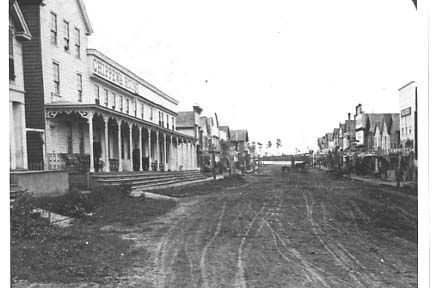
In 1923, Stanley Newton published “The Story of Sault Ste. Marie and Chippewa County.” This is part thirty-three of a continuing series about the history of Sault Ste. Marie and the area in its early years. I have left punctuation and grammar intact. – Laurie Davis
The Immigration Service
Inspector R. H. Brondyke and his men, in the Sault Ste. Marie Immigration Division, are a part of the United States Department of Labor. One of their duties is the turning back of unaccredited or undesirable aliens. Sault Ste. Marie is the only point of easy ingress from Canada in hundreds of miles of frontier, and boat and rail immigration here is heavy.
U.S. Customs Service
Deputy Collector of Customs Robert H. Taylor and his force are part of the U.S. Treasury Department personnel. Imports and exports of all merchandise through the Sault Ste. Marie gateway are recorded by this office, and duties aggregating huge sums are collected. Pulpwood for paper manufacture is one of the heaviest articles of import here, and packing house products from the Twin Cities, destined for trans Atlantic ports, are a considerable item of export.
The Weather Bureau
The United States Weather Bureau at Sault Ste. Marie is in charge of Observer Alexander G. Burns, and it is a branch of the Department of Agriculture. The Bureau building stands beside the ship canal through which all ships taking the American side must pass, and notice of impending storms as well as their direction is imparted to mariners by means of flag signals and bulletins. The Bureau is also very useful in the winter season to the railroads and to handlers of perishable merchandise, in giving advance notice of storms and cold waves.
The Internal Revenue Department, 4th District, State of Michigan, maintains a Soo office in the federal building in charge of Mr. Theodore B. McKinney.
The Post Office
Last, but really first in point of daily contact, in the list of Uncle Sam’s beneficent activities in this vicinity, is the Sault Ste. Marie post office, under Postmaster Wm. M. Snell and Assistant Postmaster John A. Graham. About thirty people are employed, and the average daily turnover is 30,000 pieces of mail. This average is greatly exceeded in the beautiful days of summer, when throngs of tourists migrate hither to escape the heat of other regions and to enjoy a holiday amid cool and lovely surroundings.
What Visitors See Here
What has the Sault to offer the stranger, the sightseer, the tourist?
The answer is: more probably than any other community of its size in the world. To enumerate just a few elements of interest: Fort Brady, a city in itself, is situated on a plateau above St. Mary’s River about one-half mile south of the ship canal and the locks. The modern brick buildings of the fort were constructed on this plateau at a cost of nearly half a million dollars. Military men consider Fort Brady one of the country’s best posts. While it is in the city limits, it is practically independent of Sault Ste. Marie.
A City Within a City
Captain Clinton Rush, of the Second United States Infantry, his officers and his 300 or more troops have, besides their commodious and spotless quarters, their own schools, theatre, post office, libraries, clubs, barber shops, newspaper, tailor shops, gymnasium, commissary, bakery, parade ground, recreation field, skating rink, hospital, and recreation rooms. Uncle Sam is lavish with conveniences for his soldiers, and he provides them with more than homelike comforts.
The Tonic Climate
The health-restoring qualities of the climate, the air, and the water have been proven many times at this post. Troops arriving from service in Cuba, the Philippines, and other semitropical, malarial, and enervating districts have been restored in a marvelously short time to health and vigor.
A Crowning Attraction
St. Mary’s Falls Canal and its battery of locks display the greatest continuous close-range procession of freight and passenger steamers in the world. They are visited yearly by thousands of fascinated spectators from the ends of the earth. Nowhere else on the globe is there such an example of man’s victory over nature’s obstacles. No movie offers so gigantic and vibrant a panorama, in so beautiful a setting. The spectacle never ceases during the navigation season, for the ships never cease coming, and hundreds of powerful electric lamps turn night into day.
The Sense of Power
At the locks, there is a sense of power on every hand. Power in the monstrous steel canoes of the white man, slipping so easily by; in the ponderous swinging gates; in the outrush of the waters as the locks are emptied; in the shining electric and hydraulic machinery on all sides; and most of all in the irresistible lifting of the giant carriers and their cargoes within the locks as the gateman moves his magic lever. It is no wonder the visitor forgets his dinner in his astonishment and delight at the wonders surrounding him, or pesters the lockmen with queries and discussions. Ask all the questions you like; you will never ruffle the good nature of Uncle Sam’s lockmen. They are famed for their courtesy. And they are, in all truth, among the world’s most useful men.
The Magic of Transportation
As the lock gates swing here, our Government takes a new place among the nations. As a direct result of that easy step, great ore pits deepen on the Mesaba Range, and a hundred thousand farms blossom on the western prairies. The flour ground yesterday in Duluth or Minneapolis finds a market a few days hence in London. Bread is cheaper in a multitude of foreign and domestic homes because of St. Mary’s Falls Canal; it lessened the cost of the homes as well. The copper ingots descending here today will be transformed tomorrow into cables in Ceylon, or trolley wires in Australia, or armatures in Egypt. Uganda spans her ravines with bridges made of this cheaply transported ore passing by; these narrow walls made Pittsburgh and Gary possible. Our mighty dreadnaughts sailed this inland waterway before they sniffed the salt. The locomotives of Brazil rode over these stone sills, and so did the rails that bear them. In fine, St. Mary’s Falls Canal has been a vital factor in the country’s supremacy in transportation, mining, manufacturing, and agriculture.
The Biggest Jack-Knife on Earth
The visitor may see just above the locks and spanning the ship canal, the largest jack-knife bridge in the world. Stupendous in bulk, it is so delicately balanced that fifty electric horsepower suffice to set its leaves in motion, and ten are ample to keep them moving.
The water-power canals and power-houses of the Michigan Northern Power Company and the Edison Sault Electric Company confirm the Soo as an electric town. They furnish electric current for every conceivable purpose except one. A fortune is begging for the genius who will show us how to heat our buildings efficiently and economically in the winter season with this abundant store of electricity.

- Canoes Light and Graceful - September 1, 2026
- Dogs Pulled Heavy Loads - August 2, 2026
- Stones Contained Spirits - July 2, 2026












Quite an interesting read! Thanks for sharing.
Thank you for commenting.