
In 1923, Stanley Newton published “The Story of Sault Ste. Marie and Chippewa County.” This is the last part of the series of Sault Ste. Marie and the area in its early years. I have left punctuation and grammar intact. – Laurie Davis
A Spontaneous Response
The response was gratifying indeed. Thousands came, and were glad they had come. Entertainment in abundance was provided daily, there was a big community picnic, and a monster parade graced by the queen of the week. Miss Lena Ladd, and her maids. A day was set apart for the reception of Soo, Ontario, and Algoma citizens. They came with the greatest of goodwill, in masses that swamped the trains and ferries. Seldom has the city entertained such crowds.
“I Remember When”
The local newspapers gave the affair an endless amount of publicity, and The Evening News published a booklet, “I Remember When,” filled with recollections of former days by many old timers. It stimulated a healthy home town spirit and resulted in the collection of much interesting and historically valuable data.
It is proposed to collect and publish separately in as complete a form as possible the data and chronology of Sault Ste. Marie’s and Chippewa’s activities in the World War. Present records are scattered and incomplete. Justice and gratitude to our soldiers and sailors demand that a permanent record of their deeds shall be preserved for their posterity and for all of us.
The City Finds Itself
Visitors pronounced the city more beautiful than they had ever seen it. Community spirit had been aroused and refreshed by the occasion, and the town put on a new dress as it were to receive its guest. The civic benefits were tremendous and undoubtedly will be lasting. Sault Ste. Marie found itself as never before, and so complete was the success of Mr. Adam’s idea that a Homecoming Week will be celebrated every five years in the city by the rapids for all time to come.
The Historical Society
Some years ago, Judge Charles H. Chapman instituted a Michigan Pioneer and Historical Society Chapter in Sault Ste. Marie. A beginning has been made in marking local points of historic interest, of which there are many. The society collaborated with the public and parochial schools of the city in the staging of a wonderfully beautiful historical pageant in Brady Field in June, 1920, under the supervision of Miss Edith Eicher. The pageant was enacted on precisely the one hundredth anniversary of the coming of Governor Lewis Cass to Sault Ste. Marie, and within a few rods of the spot where he hauled down the flag of Great Britain.
The Historic Hill and Ravine
The romantic history of the locality is to many, one of its chief attractions. A halo of historical interest hovers over the ravine in Brady Field and the little hill nearby. Once the ravine debouched upon the shore of the river, a natural landing place, long before the making of Brady Field. Ere the coming of the whites, this cleft in the bank endured the tread of many an Indian potentate and warrior, hither bound for council, for war or for food.
These Came in Canoes
It is likely that Brule and Grenolle landed there, at the foot of the rapids. A glorious band followed them. Nicolet stood at the top of the ravine and looked westward for China. Jogues and Raymbault ministered to the Indians and raised the first cross nearby. Joliet and Pere, De Lusson, Allouez, Radisson and Groseilliers, Charlevoix, Menard, Marquette, Dablon, La Hontan, Tonty, Dollier, Galinee and Cadillac; Du L’hut and Albanel; de Repentigny, Henry and Cadotte; Selkirk, Carver, Astor, Johnston, and all the rest; what a mighty host were they of explorers, voyageurs, swashbuckling soldiers, rollicking adventurers and dauntless priests, lusting for discovery, for great undertakings, for furs and for souls.
The Steamboat Comes
After them, when the steamboat was crowding the canoe to the banks, Cass came, a looming figure in Michigan history, and he made history here. With him came Schoolcraft, and the latter remained and became one of the greatest of our citizens. There followed McKenney and Brady; Bingham and Baraga, Mrs. Jameson and Franchere; Peter White and Agassiz; Kohl and Easterday, Weitzel and Poe and more; history makers and history reorders, doing their share to bring a vast region into recognition and a city into being.
The Overland Route
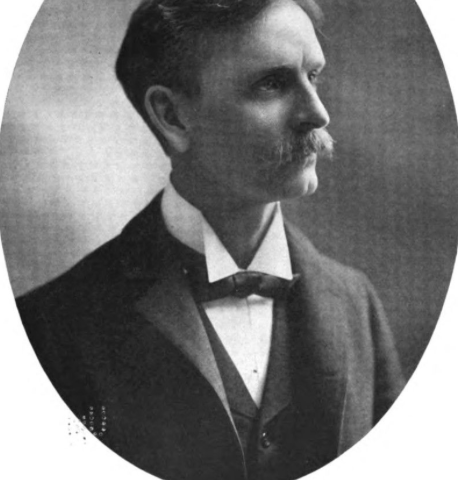
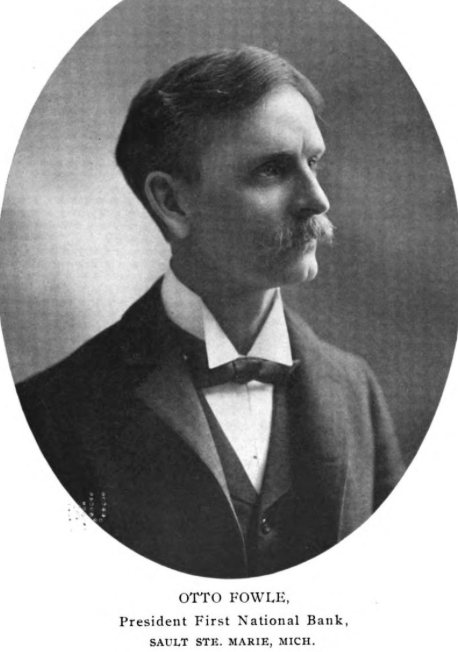
Finally, on the overland route came Mead and Fowle, establishing the first bank and giving the signal, as the chronicler says, for business to go ahead; Steere, Sutton and Chapman, exemplifying and administering the law in a district once noted for lawlessness; Clergue, the inspired dreamer and doer; Osborn, foremost citizen, magnetic in personality and surpassing in oratory, climbing from unpropitious beginnings to the Governorship of his State.
These and a multitude of others have sojourned here. Some of them are with us now, adding their meed of service to that of the men and women living here and who were born here, and enjoying with them the benefits of life in one of the finest communities in all the earth.
This is the Hiawatha Country, discovered by Schoolcraft and immortalized by Longfellow. Gitchi Manito still broods benignly over its lands, its forest and its lakes. Manibosho and his wife still sleep a long sleep on the rocky shore, awaiting the day when Pau-puk-kee-wis shall awaken them with his magic runes.
With his right hand Hiawatha
Smote amain the hollow oak tree,
Rent it into shreds and splinters,
Left it lying there in Fragments,
But in vain for Pau-puk-kee-wis,
Once again in human figure,
Full in sight ran on before him,
Sped away in gust and whirlwind,
On the shores of Gitchee-Gumee,
Westward by the Big-Sea-Water,
Came unto the rocky headlands,
To the Pictured Rocks of Sandstone,
Looking over lake and landscape.
The Soo Locks At Evening
I like the locks at evening best,
When suns grow golden in the west
And linger on their outward quest.
The searching suns, who scan the sphere,
Nor match from swinging year to year
The loveliness unfolded here,
They linger, as if loath to sink
Beyond old Gitchi Gumi’s brink.
When they grow golden-pink and white,
Halting the squadrons of the night,
They ring the clouds with chrysolite,
And crown these roofless channeled halls
Whose guests are ships, these gates and walls,
A field for fairy festivals.
When suns grow golden in the west,
I love the locks at evening best.

- A Spontaneous Response - April 8, 2026
- God Loves Immigrants - March 5, 2026
- Points of Historic Interest - February 19, 2026

